
Active Warrants in Tarrant County
Warrants in Tarrant County come from more than one place. A judge or magistrate signs the order. The Tarrant County Sheriff's Office, run by Sheriff Bill E. Waybourn, serves many of them. Courts issue arrest warrants, bench warrants, and capias orders. The clerk of the court that issued the order keeps the file. So an active warrant is tied to a court, a charge or a missed deadline, and an agency that will carry it out.
Here is the part that surprises people. Criminal warrant information is not generally released to the public. Guidance from official and near-official sources says this data is provided to licensed bail bondsmen, attorneys, and law enforcement agencies, not to anyone who walks up and asks. A name search will not always confirm an active warrant. If you think a warrant exists, the right move is to contact an attorney, the issuing court, or law enforcement rather than trust a third-party site.
Important: There is no public name lookup that promises to confirm every Tarrant County criminal warrant; that data flows to bondsmen, attorneys, and police, not the open public.
Types of Warrants in Tarrant County
Not all warrants mean the same thing. The label tells you who issued the order and why. Some come from a fresh charge. Others come from a missed court date or an unpaid fine. A few involve another county or another state. Knowing the type points you to the right court and the right way to fix it.
- Arrest warrant - an order that lets police arrest a person based on probable cause that a crime was committed.
- Bench warrant / capias - issued by a judge after a failure to appear, a contempt finding, a probation problem, or to enforce a judgment.
- Capias pro fine - used in fine-only and traffic cases after a judgment when the fine is not paid or terms are not met.
- Search warrant - authorizes a search or seizure, and it may stay sealed while an investigation is open.
- Fugitive warrant / hold - an out-of-county or out-of-state warrant or detainer placed on a person.
- Civil writs - court enforcement orders such as a writ of attachment, commitment, possession, execution, or garnishment.
A capias pro fine often starts with a small ticket. You miss the answer date or skip a payment, and a fine-only case can turn into a warrant. That is why many traffic matters end up here. The traffic court records page covers how citations move toward a warrant when deadlines pass.
How to Search Tarrant County Warrants
There is no single public box that lists every active warrant by name. The honest path is to work the channels that do hold warrant data. The Tarrant County District Clerk runs a public document search through its publicsearch portal, and that portal defaults its Department field to Warrants. It points at district court documents, not at the full criminal warrant pool. So treat it as one tool, not a complete answer.
The Sheriff's Office posts a Most Wanted list and links to bond and booking information, but it does not promise to confirm a private person's warrant on demand. If you suspect a warrant, here is a sensible order to work through.
- Gather your paperwork. A citation, a case number, or a court letter names the court and the charge or fine behind the order.
- Open the District Clerk public search and leave the Department set to Warrants, then enter a name or document term and a date range.
- Check the official Tarrant County Sheriff page for Most Wanted and bond links, and call the issuing court clerk to ask about your options.
- For a criminal arrest warrant, contact a defense attorney or a licensed bondsman, since those channels can confirm what the public portal will not.
- If the person is already booked, run an inmate search to read custody and bond status instead of hunting a warrant record.
The Criminal District Attorney also publishes news releases that sometimes name charged or wanted people. Its 2025 news release archive is a public, official source for that kind of update.
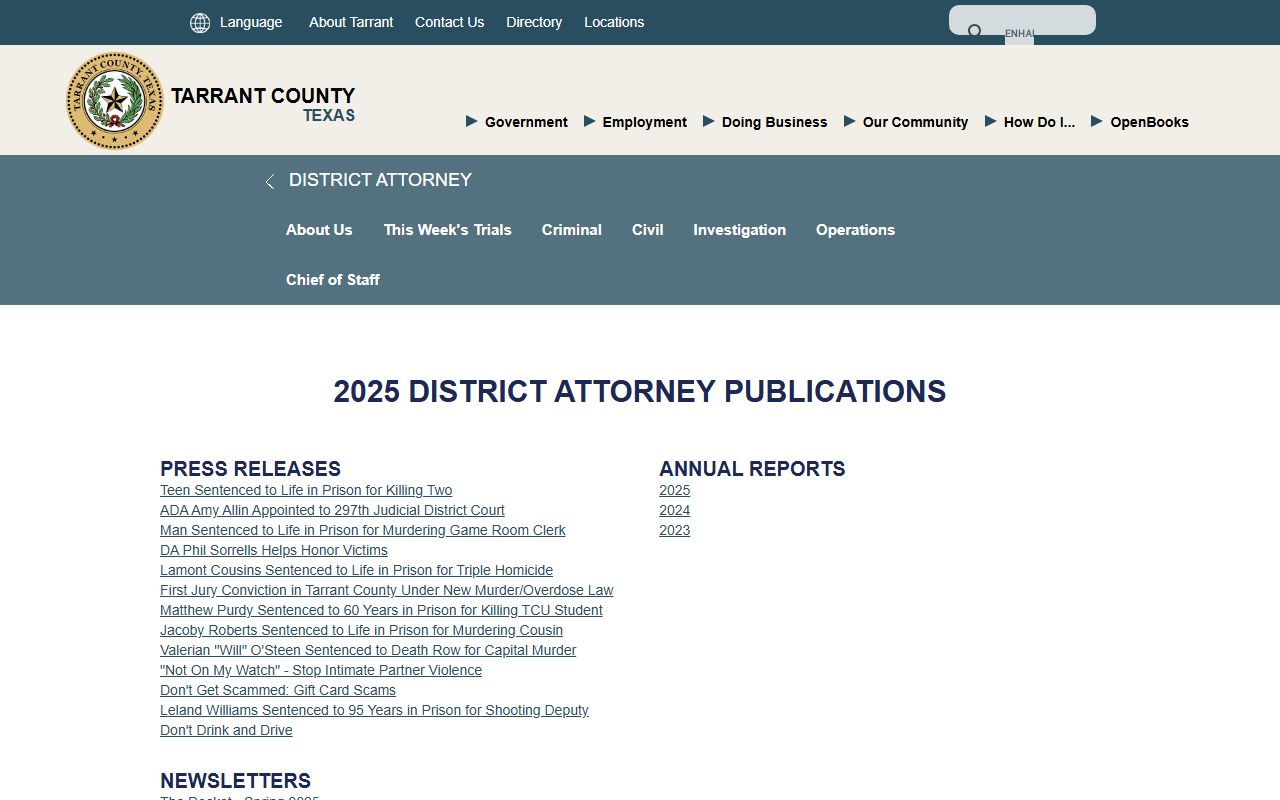
These releases are not a warrant database, but they show how the county shares charge and enforcement news through official channels rather than private sites.
Tarrant County Warrant Search Fields
The District Clerk public search uses a small set of fields. You do not need to fill every box. A name or a document term plus a date range is enough to run most queries. For warrant questions, leave the Department set to its Warrants default and start there.
| Field Label | Type | Required | Notes / Format |
|---|---|---|---|
| Department | Dropdown | No | Defaults to Warrants for this portal |
| Search Term | Text | No | Name, document term, or index term |
| Date Range | Date range | No | From and to dates, based on recorded date |
| Quick date filter | Buttons | No | Last 24 Hours through Last 1 Year |
| Search scope | Radio | No | Index Only, or Index and Full Text (OCR) |
Reset Search clears the form so you can try a new spelling or date window. Remember the limit: this portal reaches district court documents, so it will not surface every criminal warrant held across all courts and agencies.
What a Tarrant County Warrant Record Shows
When a warrant record is visible, it carries a set of identifying fields. These let a court, a bondsman, or an attorney confirm the order and the terms tied to it. A live public warrant sample was not safely captured during research, so the fields below reflect the standard inventory rather than a single screenshot.
| Field | What It Shows |
|---|---|
| Name | The person the warrant is issued against |
| Cause Number | The case or cause number tied to the order |
| Court | The court that issued the warrant |
| Charge | The offense, or the judgment basis for a capias |
| Issue Date | When the warrant or capias was issued |
| Bond | The bond amount and type, if a bond is set |
| Issuing Agency | The court or agency behind the order |
| Status | Active, served, or resolved, with a served date if cleared |
A bond line is one of the most useful parts. It tells a person what it may take to address the warrant and avoid sitting in jail. Bond can be cash, surety, or personal, and the amount depends on the charge and the court. The arrest records page explains how a charge connects to a booking and a case file.
What to Do If You Have an Outstanding Warrant
Do not ignore a warrant. The order does not expire on its own, and a routine traffic stop can turn into an arrest. The first step is to learn what kind of warrant it is and which court issued it. Your citation, your case paperwork, or a case search can name the court and the reason. Once you know the source, you can pick the right channel to resolve it.
A criminal arrest warrant is different from an unpaid-fine capias. For a criminal charge, jail risk, or a bond question, talk to a defense attorney before you act. For a Justice of the Peace or municipal citation, or a capias pro fine, the court clerk can explain appearance, payment, or compliance options. The steps below lay out a clear order.
- Do not ignore the issue, and do not wait for it to disappear.
- Identify the issuing court or agency from your paperwork, your citation, or a case search.
- Contact an attorney if a criminal charge, jail risk, or a bond is involved.
- Contact the court clerk for appearance, payment, or compliance options when it is a JP or municipal citation or a capias pro fine.
- For a criminal arrest warrant, use the attorney, bondsman, or law-enforcement channel, since the Sheriff will not confirm it to the open public.
- If you are already in custody, use an inmate search for your CID, custody status, and bond information.
- After it is resolved, confirm the court cleared the warrant and allow processing time before you assume any database is updated.
Important: Talk to a licensed attorney before you turn yourself in, since a lawyer can arrange bond and protect your rights before any arrest happens.
After a Warrant Is Resolved
Clearing a warrant is not instant in the data. A court enters the resolution first. Agency systems and any public portal update later. So a served or recalled warrant may still show as active for a short time. Allow processing time before you assume the record is current.
If a person was booked into the jail on a warrant, the next question is custody status, not the warrant itself. The Sheriff's inmate search shows whether someone is held, their CID, and bond details. After release, the released inmates page covers how to confirm a release and set up notifications. For the full roster and how to read a result, see Tarrant County inmate records.
The Criminal District Attorney keeps posting current enforcement news as the year moves on. Its 2026 news release archive is the official place for the latest charge and prosecution updates.
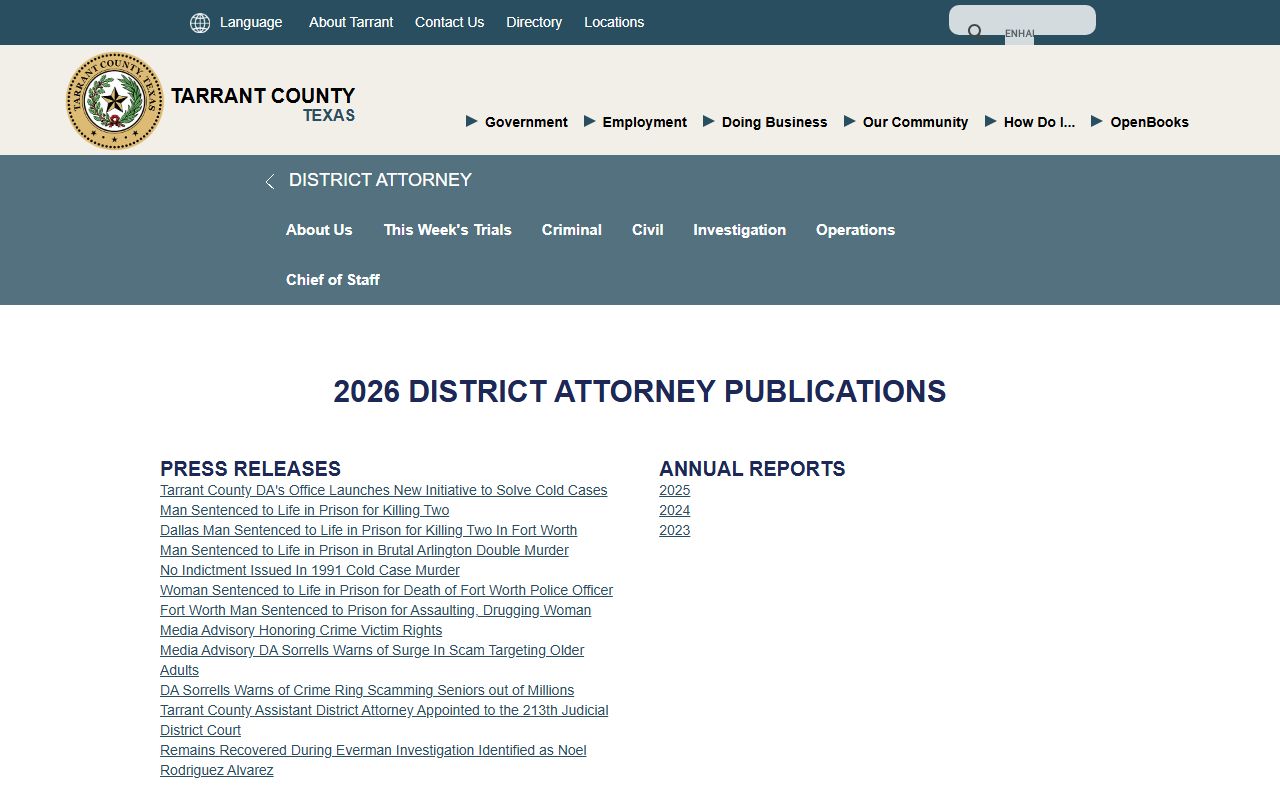
Use official county pages like this one to track real updates, since private warrant sites often run on stale or unverified data.
Crime Stoppers and the Most Wanted List
The Sheriff's page links to Most Wanted PDFs that name people sought on warrants or charges. Crime Stoppers may pay a reward for a tip that leads to an arrest. This is the public-facing side of warrant work, since the county wants help locating wanted people. It is not a tool to confirm your own warrant.
Safety comes first here. Do not approach a wanted person. Submit a tip through Crime Stoppers or law enforcement and let trained officers act on it. Tips can be anonymous, and the reward structure is built to protect the person who calls in.
Note: Never try to detain or confront a person listed as wanted; pass the information to Crime Stoppers or police and stay clear.
Restricted Tarrant County Warrant Records
Several warrant types are not open for public browsing. A search warrant can stay sealed while an investigation is active, so its details are held back until a court unseals it. Juvenile matters carry confidentiality protections under Texas law. Some sensitive records are limited to parties, attorneys of record, and people a court allows by order.
Federal warrants sit outside the county system entirely. They run through federal courts and federal agencies, not the Tarrant County Sheriff or the District Clerk. And the broad rule still applies across the board. Criminal warrant information is not generally released to the public. It goes to licensed bondsmen, attorneys, and law enforcement, which is why a private website cannot honestly promise a complete warrant lookup. To understand which case records are open and which are sealed, see the court records page.