
How to Find Recently Released Tarrant County Inmates
Tarrant County does not post one fixed "recently released" page. There is no clean list of names that walked out yesterday. Instead, you read release status off the live inmate search. The roster table shows an "In Custody?" column for each person it returns. When that column flips, the person is no longer held on that record. So the search itself is the tool. You check whether someone still shows as held, and you watch that column to confirm a release.
Start with a name or a CID number. The county roster lets you look up a person and read the custody flag. If the name no longer comes back, or the custody status changes, that points to a release or a transfer. For the full roster, how to enter a search, and what each result field means, use the Tarrant County inmate records page. That page walks through the lookup tool in detail.
Recent activity also shows up in the Sheriff's daily reports. Booked-in reports and bond reports, when linked from the Sheriff page, give a window into who came and went over the last day. They are not a release log, but they help. If you do not trust what the roster shows, the next step is a phone call. The jail keeps a records line for exactly this kind of question.
Verifying a Release in Person or By Phone
Online data can lag. A release that happened an hour ago may not show on the roster yet. If you need a firm answer, especially for a legal or safety reason, confirm it with a live person. The Sheriff's Office runs a jail information line and a Detention Bureau line. Staff can check current custody status against the official system, which the public roster only mirrors.
Have the person's full name ready. A date of birth or a CID number helps a lot. Call the jail information number for general custody questions. Use the Detention Bureau main line for bureau matters. Both numbers reach the people who manage the five-facility jail system here in Fort Worth.
- Run the name first on the county inmate roster and note the "In Custody?" result.
- Write down the full legal name, any known date of birth, and the CID number if you have it.
- Call Tarrant County Jail information at 817-884-3116 for custody status.
- For Detention Bureau matters, call the main line at 817-884-3000.
- Ask staff to confirm current status, since the roster can trail the live system by minutes or more.
- If the person moved to state prison, follow up with the TDCJ search; if federal, use the BOP locator.
Note: The online roster is a public service that mirrors the jail system, so always confirm a release by phone before you rely on it for any legal or safety decision.
Setting Up Release Notifications
You do not have to check the roster over and over. A free alert service can do the watching for you. VINELink is the public face of the VINE custody notification network. You register a person of interest, pick how you want to be told, and the system pings you when custody status changes. Many people use it for safety reasons, such as a victim who wants to know the moment a defendant is released. The county victim services office also points people toward state notification tools that update around the clock.
The lead-in step is to open the alert portal, which you can reach at VINELink. The page lets you search by state and name, then build an alert profile. Registration is what turns a one-time search into a standing notification.
The VINELink custody notification portal lets you sign up for phone, email, or app alerts in a few minutes.
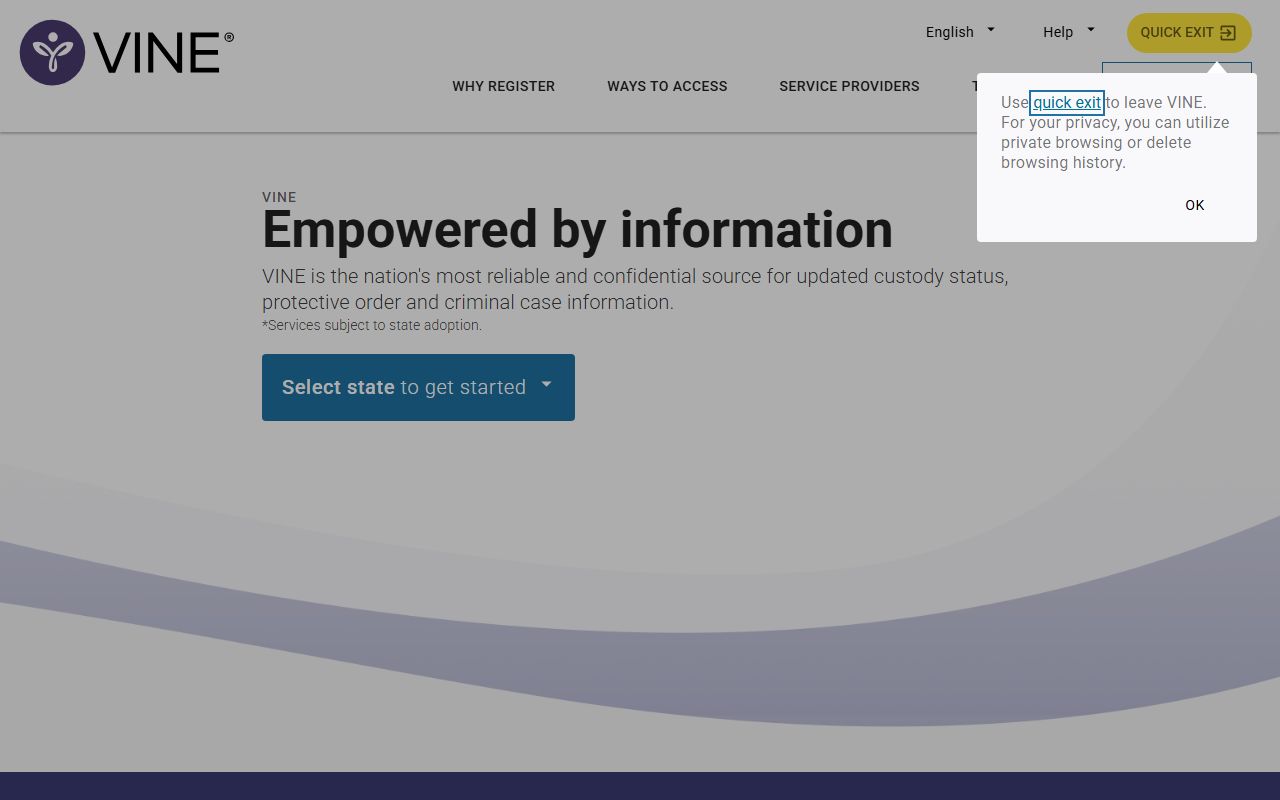
From that screen, you choose Texas, search the name, and set your contact method so an alert reaches you fast.
| Field Label | Type | Required | Notes |
|---|---|---|---|
| State | Dropdown | Yes | Select Texas or the relevant state. |
| Name / ID | Text | No | Offender name or ID, depending on the agency. |
| Facility / agency | Dropdown filter | No | Availability varies by agency. |
| Notification method | Account fields | Required for alerts | Phone, email, or text/app options vary. |
- Open VINELink and pick Texas from the state list.
- Search by the offender name or ID to find the right record.
- Register an account and pick a notification method to start the alerts.
Searching State and Federal Released Inmates
Not everyone released from a case stays in the county system. A felony sentence can send a person to state prison. A federal charge sends them to federal custody. When that happens, the county roster will not track them anymore. You switch to the matching state or federal locator. These tools cover prison custody and, in the state's case, parole context that the county jail never holds.
For state prison, the Texas Department of Criminal Justice runs an inmate search at the TDCJ Inmate Search. Use it when someone was sentenced and moved out of the Tarrant County Jail. It is built for prison and parole status, not for pretrial county custody. The table below shows the fields the TDCJ search uses.
| Field Label | Type | Required | Notes |
|---|---|---|---|
| Last Name | Text | Varies | State inmate lookup; use for prison or parole context, not county pretrial custody. |
| First Name | Text | No | Narrows the search. |
| TDCJ Number | Text | No | Best result if you know it. |
| SID Number | Text | No | State ID number. |
| Gender / Race | Filters | No | If shown on the live form. |
For federal custody, the Bureau of Prisons keeps its own tool. The BOP Inmate Locator covers people held in federal prisons, and it returns federal custody only. You can search by a number or by name. If a Tarrant County case got picked up federally, this is where the trail goes.
| Field Label | Type | Required | Notes |
|---|---|---|---|
| Find By Number | Tab / radio | No | BOP Register Number, DCDC, FBI, or INS number. |
| Find By Name | Tab / radio | No | First, Middle, Last, Race, Age, Sex. |
| Search | Button | n/a | Returns federal custody only. |
The Texas Sex Offender Registry
Some people leave custody but stay on a public registry. The Texas Department of Public Safety runs the statewide sex offender registry. It is open to the public and built for location searches. You can look up a name, or you can search by address, city, or ZIP to see who is registered near a place. There is a county filter too, so you can pull Tarrant County records on their own.
Open the registry at the Texas DPS Sex Offender Registry. The site supports map and radius searches, which helps when you want a picture of a neighborhood rather than one person. Pick Tarrant in the county dropdown for local results only.
| Field Label | Type | Required | Notes |
|---|---|---|---|
| Name search | Text | No | Last and first, or name fields depending on the mode. |
| Address / city / ZIP | Text | No | Location-based search. |
| County | Dropdown | No | Choose Tarrant for county-specific registry records. |
| Map / radius | Map filter | No | The registry supports geographic searching. |
Holds, Transfers, and Bond Release Timing
A release is rarely instant. After a bond is posted, staff still run warrant checks, confirm there are no holds, and process paperwork. That all takes time. The timing depends on payment processing, those warrant checks, any holds, and court orders tied to the case. So a person can show as held for hours after the money clears.
Holds are the big reason a release stalls. Another agency can place one. Parole, ICE or other federal detainers, and outstanding warrants can each block a release even when a local bond is paid in full. The county may have nothing left to hold the person on, yet they stay because someone else does. That is when a case shifts from the jail to a state or federal track.
Release can come several ways. A person leaves after a bond is posted, a court order, a dismissal, a finished sentence, a transfer to another jurisdiction, or a personal bond. Each path runs on its own clock. Personal property and stored money are a separate Sheriff topic; a person being released usually gets their stored property and paperwork back as part of the process. If a release seems stuck, a hold is the first thing to ask about. You can also check the warrant records page, since an open warrant is a common cause.
Parole and Probation Information
Release from custody does not always mean release from supervision. Many people leave on parole or probation, with rules they must follow. Parole covers the back end of a state prison sentence, supervised in the community. Probation, called community supervision in Texas, can replace jail time or follow it. Both come with conditions, and a violation can send a person back. State prison and parole status show up through the TDCJ system rather than the county roster.
County jail custody is mostly pretrial and short county sentences, so long-term supervision data lives at the state level. If you are tracking someone on parole, the state inmate search is the better tool than a county roster check.
Reentry Resources in Tarrant County
Coming out of jail is hard, and the county does link to help. The Sheriff's Detention Bureau navigation points to Tarrant County Re-entry Services. Inside the jail, programs run while a person is still held: GED and ESL classes, counseling, medical and psychological care, a law library, and a recreational library. The goal is a smoother return to the community and a lower chance of coming back.
Outside the jail, legal and civil help matters as much as housing and a job. A released person often has court paperwork to sort out, an expunction or nondisclosure to pursue, or a benefits issue. Several official and nonprofit groups handle that work for low-income residents.
These resources cover legal aid, self-help forms, and statewide guidance.
- Tarrant County Re-entry Services - linked from the Sheriff's Detention Bureau pages for people leaving custody.
- Legal Aid of Northwest Texas - free civil legal help for qualifying low-income residents, including some expunction and nondisclosure clinics.
- Texas Law Help - plain-language forms and guides for expunction, nondisclosure, name change, and more.
- Tarrant County Lawyer Referral Services - connects residents to local attorneys when a matter is not eligible for legal aid.
Self-help forms and guides on Texas Law Help walk a person through an expunction or a nondisclosure step by step. Those filings can limit who sees an old record after a case is done.
Rights After Release
Some rights pause during a sentence and come back when it ends. Voting is the clearest case. In Texas, a felony conviction affects voting while a person is incarcerated, on parole, or on probation. The right to vote restores once the full sentence, including any supervision, is discharged. The exact wording is worth confirming with the Texas Secretary of State, but the basic rule is that finishing the sentence brings the vote back.
Firearm rights are harder. A felony conviction, and some protective orders, can restrict firearm possession under both state and federal law. Getting those rights back is not automatic; it takes legal analysis and often a formal process. Do not assume a release alone restores them.
A driver license can also need fixing after a case. The Department of Public Safety says a court correction may take up to 21 business days after DPS receives the official correction notice. So if a record needs to update on a license, plan for that wait. For the arrest entry behind a record, the arrest records page explains how charges and outcomes differ and how to read them.
The Tarrant County Jail System
It helps to know the system a person is released from. The Tarrant County Jail is large. It holds about 5,000 inmates across five facilities and books roughly 35,000 people a year. Everyone comes in through central booking at the Corrections Center, where they are photographed and iris-enrolled before housing. Releases run back out through that same machinery, which is part of why timing varies.
You can read the background on the county's own site. The lead-in is the history of the Tarrant County Jail page, which lays out how the facilities grew over time.
The jail history page gives context for how the modern five-facility system handles intake and release.

Knowing the scale of the system explains why a release can take time and why holds matter so much. For day-to-day counts and capacity, see the inmate population page.