
How to Search Tarrant County Court Records
There is no single box for every court. You pick the portal that holds your file. District civil, family, and felony criminal documents go through the Tarrant County District Clerk and the Court Document Lookup service. County civil, probate, county criminal, marriage, real property, and assumed name records go through the County Clerk Official Records Search. Justice of the Peace cases and city tickets stay with the court that filed them. Match the record to the clerk first, then search.
Before you start, gather what you have. A cause number is best. A full name plus a date range also works. Know the court if you can, and the document type you want. The County Clerk data was certified through 05/21/2026 on the date it was checked, so very recent filings may lag a day or two.
The steps below walk through a basic search on either public portal.
- Pick the portal that matches the case. Use the County Clerk Official Records Search for recorded and county records, or the District Clerk public search for district court documents.
- Type a party name or a document number in the Search Term box.
- Set a date range, or tap a quick date button such as Last 1 Year.
- Pick Search Index Only for indexed fields, or Search Index and Full Text for OCR text inside the documents.
- Open the result, check the names and dates, and order a certified copy if you need one for court.
The District Clerk also runs a Court Document Lookup service for civil, family, and felony criminal cases. You can see its main landing page on the District Clerk Court Document Lookup page, which explains the onsite tool, copy fees, and remote access.
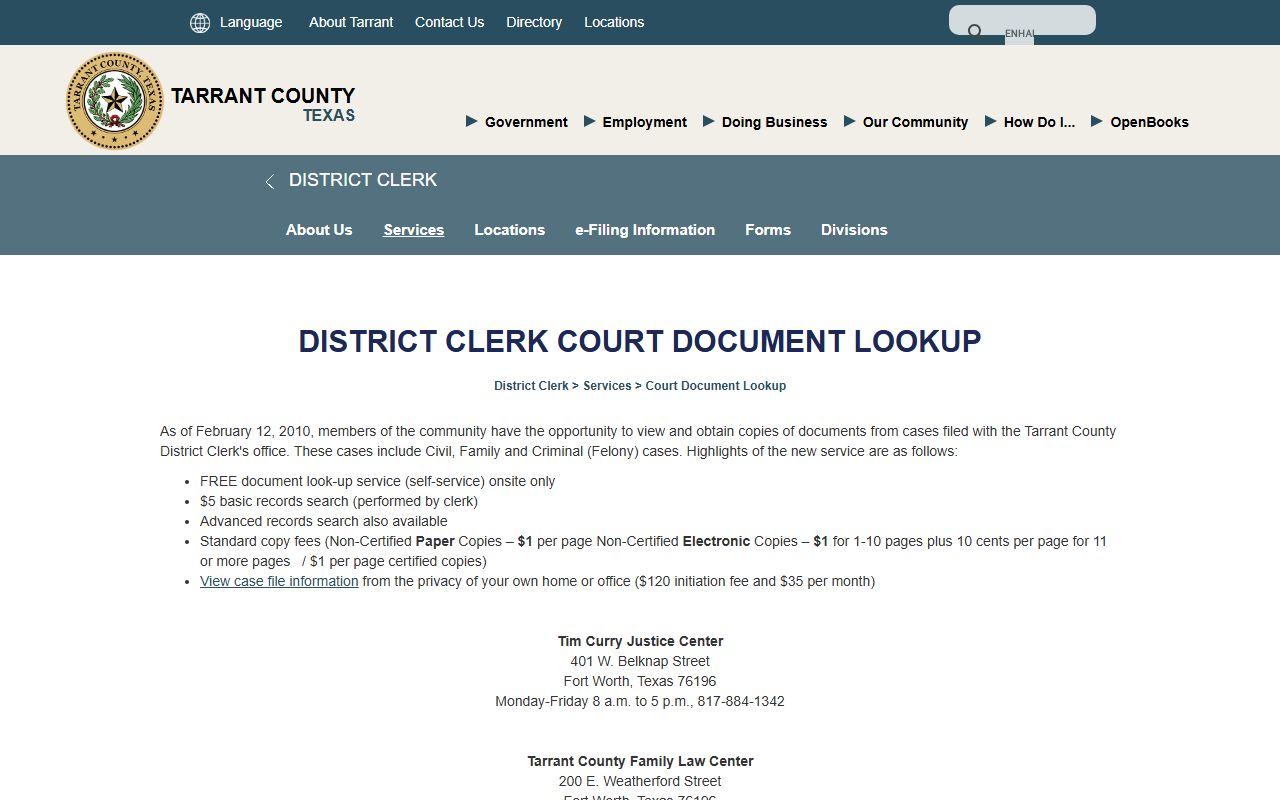
That page is the cleanest way to confirm the District Clerk fees and access rules before you head downtown or pay for remote access.
District Clerk vs County Clerk in Tarrant County
This is the single most useful fact for a Tarrant County court records search. Two clerks split the work, and they do not overlap much. The District Clerk, Thomas A. Wilder, handles the higher courts. The County Clerk, Mary Louise Nicholson, handles the county courts and recorded public records. Send your search to the wrong clerk and you find nothing, even when the record exists.
The District Clerk manages business for 28 elected courts and 22 associate judges and magistrates. The office takes in more than 61,000 new case files a year plus about 60,000 magistrate cases. It holds district civil suits, family cases at the Family Law Center, and felony criminal files from the criminal district courts. The County Clerk is clerk of the three County Courts at Law and the two Probate Courts, and also records deeds, marriage licenses, and assumed names.
| Record Type | Which Clerk Holds It |
|---|---|
| District civil and tax suits | District Clerk |
| Family and divorce cases | District Clerk |
| Felony criminal cases | District Clerk |
| County Court at Law civil cases | County Clerk |
| Probate, wills, and guardianships | County Clerk |
| Marriage, deeds, assumed names | County Clerk |
Note: When you are not sure of the case level, start with the District Clerk for anything that sounds like a felony or a major lawsuit, and the County Clerk for everything else.
Tarrant County Court Records Search Fields
The County Clerk Official Records Search uses a short set of fields. You do not need to fill every one. A name or a document number plus a date range is enough for most searches. You can see the portal layout on the County Clerk Official Records Search page.
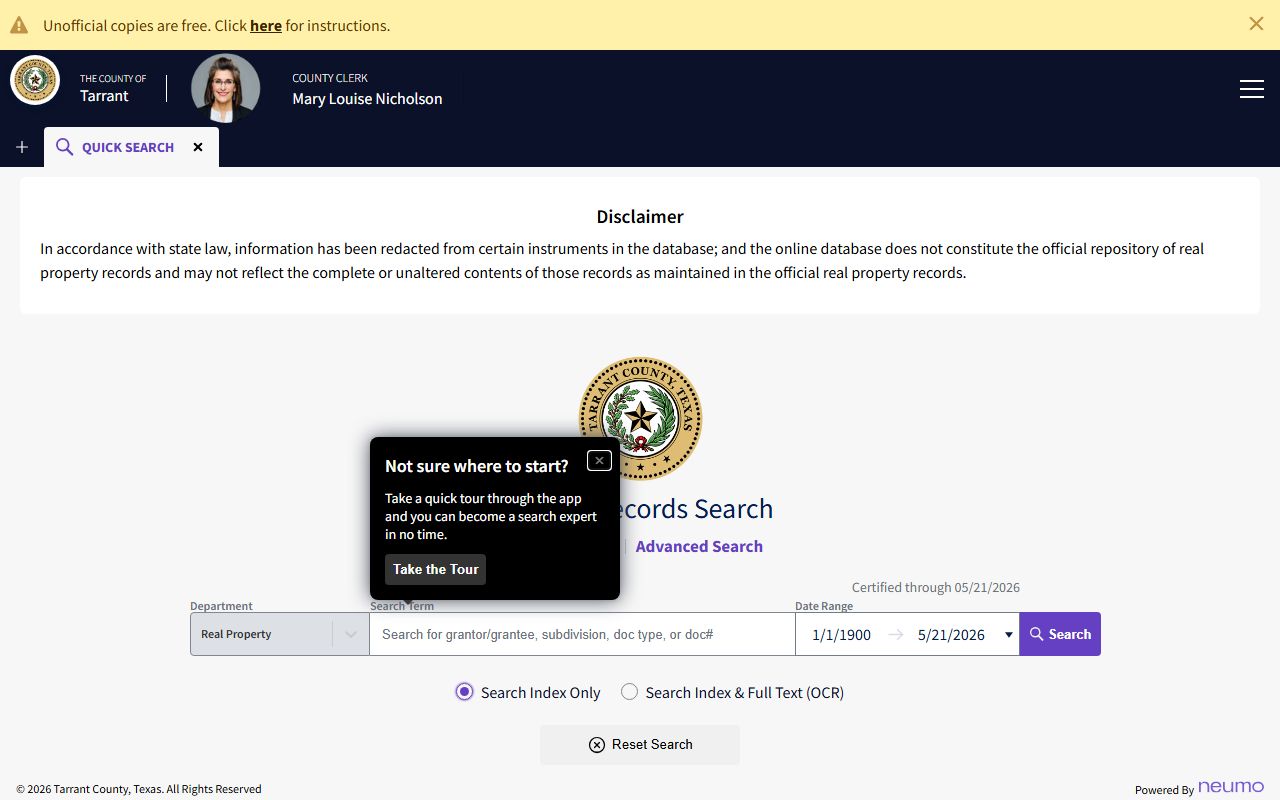
The same fields appear whether you search index data only or full document text, so the table below maps to either mode.
| Field Label | Type | Required | Notes / Format |
|---|---|---|---|
| Department | Dropdown | No | Real Property default; also Foreclosures, Marriage, Assumed Names |
| Search Term | Text | No | Grantor/grantee, subdivision, document type, or document number |
| Date Range | Date range | No | From and to dates, based on Recorded Date |
| Quick date filter | Buttons | No | Last 24 Hours through Last 1 Year |
| Search Index Only | Radio | No | Searches indexed fields; multiple words searched one at a time |
| Search Index & Full Text (OCR) | Radio | No | Searches OCR document text; multiple words searched as a phrase |
The District Clerk public search uses the same field layout. Its default department is Warrants, and it points at district court documents instead of recorded instruments. You can open it through the District Clerk public search portal.
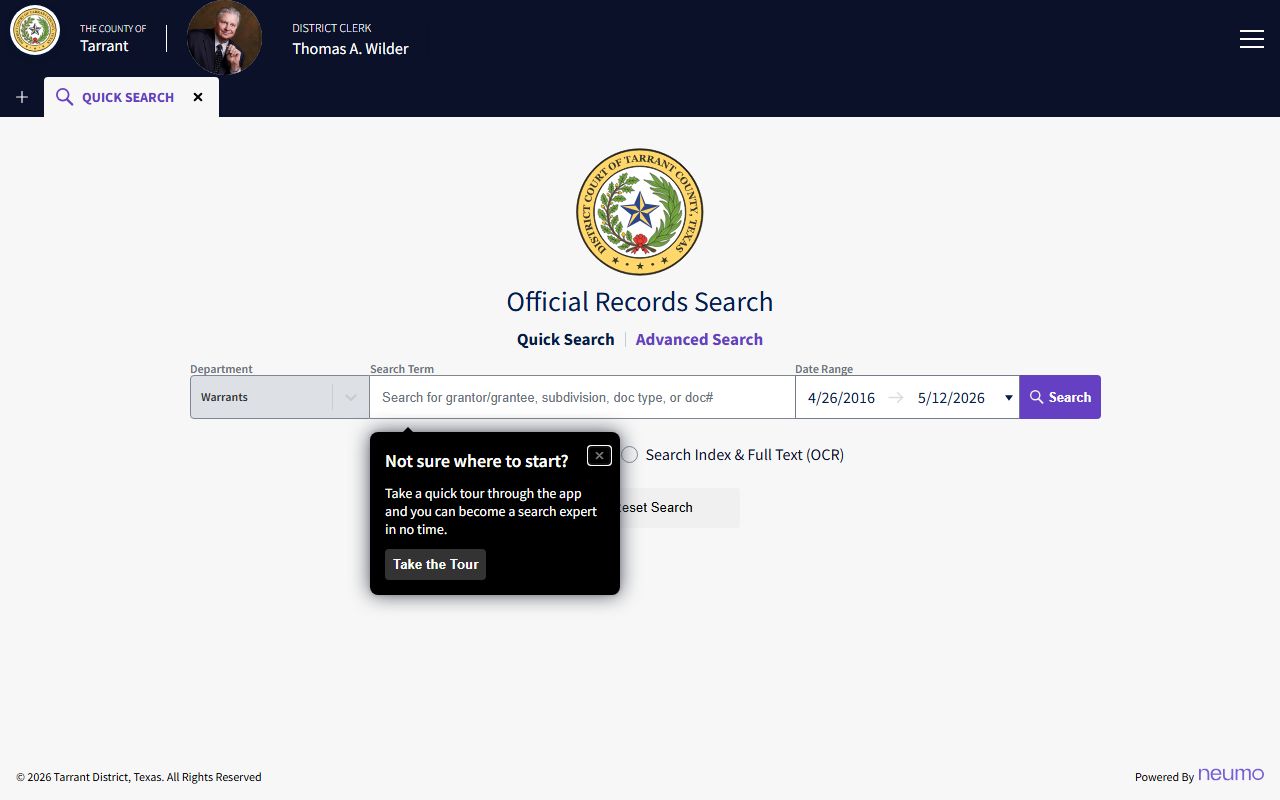
Use this side for felony, family, and district civil court documents, and use the County Clerk side for recorded instruments like deeds and marriage licenses.
Types of Tarrant County Court Records
Tarrant County court records cover most kinds of cases. The clerk that holds the file depends on the court that heard it. District-level files go to the District Clerk. County-level files go to the County Clerk. Justice and municipal courts keep their own records.
These are the main record types and where each one lives.
- Civil district records - large lawsuits, tax suits, and injunctions, held by the District Clerk.
- Felony criminal records - indictments, judgments, and sentences from the criminal district courts.
- Family and divorce records - divorce, custody, and support files from the Family Law Center.
- County civil and probate records - mid-size civil cases and estates, held by the County Clerk.
- Misdemeanor county criminal records - Class A and B cases from the county criminal courts.
- Justice and traffic records - small claims, evictions, and many citations filed in Justice of the Peace or city courts.
County Courts at Law take civil cases up to $250,000 plus probate matters. Justice Courts handle civil claims up to $20,000 and many traffic citations. For broader public records like deeds and business filings, see the Tarrant County public records page.
What Tarrant County Court Records Show
A court record is more than a name and a charge. Each file carries identifiers, parties, dates, and the path the case took. Public portals redact sensitive items like Social Security numbers, driver license numbers, and minor identifiers. The District Clerk Court Document Lookup pulls these fields from civil, family, and felony criminal cases. Here is what a typical record shows.
| Field | What It Shows |
|---|---|
| Cause Number | The court's unique case identifier |
| Court | The court and number, such as 17th District Court |
| Filing Date | When the case or document was filed or recorded |
| Parties | Plaintiff and defendant, or petitioner and respondent |
| Charges / Cause | The charge in a criminal case or the claim in a civil one |
| Docket Entries | The running list of filings, hearings, motions, and orders |
| Disposition | The outcome, such as dismissed, convicted, or granted |
The County Clerk portal sorts recorded items by document type codes. Common ones include D for Deed, DT for Deed of Trust, J for Judgment, PROB for Probate, and WILL for a will. A docket is the running log of what happened. A disposition is the result. For a deeper look at reading dockets, see the Tarrant County court dockets page.
Public Access Framework for Tarrant County Court Records
Most Texas government records are open under the Texas Public Information Act. Court records work a little differently. The judiciary follows rules set by the Supreme Court of Texas, not the standard agency request process. So you ask the clerk or court for a case file, while you ask a county department for things like sheriff administrative records. A few statutes do most of the work here. Some open records up. Others lock specific records down.
The policy basis sits in Texas Government Code § 552.001, which says each person is entitled to complete information about government affairs. But Texas Government Code § 552.0035 places judiciary records under Supreme Court rules instead of the normal request route. That is why a clerk's case file is not handled like a routine agency email. The broader judiciary rules sit with the Texas judiciary rules and standards.
You can review the official Texas court rules and standards directly through the state judiciary site.
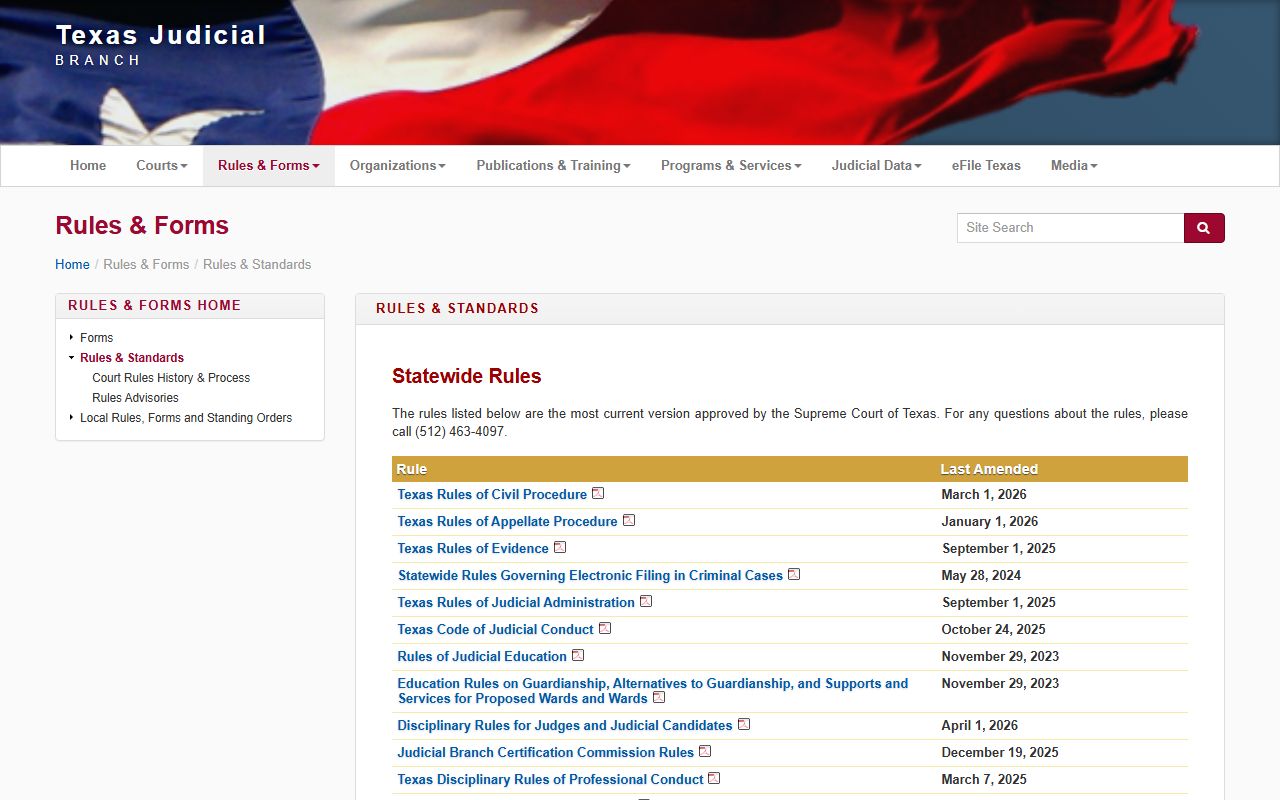
Those rules, along with clerk procedures and confidentiality laws, set what a Tarrant County court records search can return. Anyone can look at an open file. You usually do not need a reason to ask.
Note: Court records are requested through the clerk that holds the file, not through a standard open-records form aimed at a county department.
Records That Are Sealed or Confidential in Tarrant County
Not every file is open. Texas law seals or limits several record types even when a courthouse holds them. Juvenile records are confidential under Texas Family Code Chapter 58, which controls access and sealing for those files. Adoption records are sealed. Mental-health and guardianship details carry medical privacy. Grand jury work stays secret until an indictment is filed. Information made confidential by other law is shielded under Texas Government Code § 552.101.
Two tools clear a criminal record, and they are not the same. Expunction under Code of Criminal Procedure Chapter 55A removes eligible records from public use. After a final expunction order, agencies destroy, return, or delete the records as directed. A nondisclosure only hides the record from the public while police and certain agencies keep access. To view a sealed file, you usually must be a party, an attorney of record, or someone the court allows by order.
Expunction is not automatic. A person must fit a category under Chapter 55A, such as an acquittal or certain dismissed matters after a waiting period. The petition usually files in district court in the county of arrest, names every agency that holds records, and goes to a hearing unless waived. The District Clerk handles filing and records for district-court expunction cases. For the arrest side of this, see the Tarrant County arrest records page.
Tarrant County Court Records Copy Fees
Looking at a record onsite is free at the clerk's office. Copies and clerk-run searches cost money. The District Clerk Court Document Lookup is free as a self-service tool onsite, but a clerk-performed search and remote access carry fees. The table below lists the common District Clerk charges from the official lookup page.
| Item | Amount |
|---|---|
| Non-certified paper copy, per page | $1 |
| Non-certified electronic copy, 1 to 10 pages | $1 |
| Each electronic page after 10 | $0.10 |
| Certified copy, per page | $1 |
| Clerk-performed basic records search | $5 |
| Remote Court Document Lookup access | $120 setup, then $35 per month |
The County Clerk portal banner states unofficial copies are free, while certified copies use clerk fees. Confirm current charges with the clerk before you pay, since checkout and recording fees can differ from posted copy rates.
In-Person Court Record Requests
You can search and request records in person at the clerk's office. The District Clerk works out of several buildings, each tied to a case type. Civil district records sit at the Tom Vandergriff Civil Courts Building. Felony criminal files and background checks run through the Tim Curry Criminal Justice Center. Bring a photo ID and as many case details as you have, such as a cause number or a party name with dates. Office hours are weekdays, so plan your trip during business hours.
Tarrant County District Clerk
Tom Vandergriff Civil Courts Building
100 N. Calhoun St., 2nd Floor
Fort Worth, TX 76196
817-884-1574
Mon-Fri 8 a.m.-5 p.m.
Tim Curry Criminal Justice Center
District Clerk, 3rd Floor
401 W. Belknap St.
Fort Worth, TX 76196
817-884-1342
Mon-Fri 8 a.m.-5 p.m.
The County Clerk also keeps public records at the 1895 Historic Courthouse and at branch subcourthouses around the county. For deeds, marriage, and assumed names, the County Clerk page covers those offices in detail.