
About the Tarrant County District Clerk
The Tarrant County District Clerk is an elected official who serves a four-year term. Thomas A. Wilder holds the post. The office is the records hub for the county's district courts, and it is one of the largest court clerk operations in Texas. Voters pick the District Clerk, so the role answers to the public, not to any single judge. The job is broad. It mixes records, money, and court support work in one office.
The numbers show the scale. The office runs business operations for 28 elected courts and 22 associate judges and magistrates, which is 50 judicial officers in total. It employs 153 people. Each year it takes in more than 61,000 new case files plus about 60,000 magistrate cases. It also manages over $23 million held in roughly 5,000 custodial accounts for minor children and other court-ordered funds. The office produces civil citations, criminal warrants, and criminal judgments, and it serves as Magistrate Clerk for the county.
The District Clerk operates from several court buildings, not one. The main civil records office sits in the Tom Vandergriff Civil Courts Building.
Tom Vandergriff Civil Courts Building
District Clerk: Thomas A. Wilder
100 N. Calhoun St., 2nd Floor
Fort Worth, TX 76196
817-884-1574
Mon-Fri 8 a.m.-5 p.m.
Tim Curry Criminal Justice Center
401 W. Belknap St., 3rd Floor
Fort Worth, TX 76196
817-884-1574
Mon-Fri 8 a.m.-5 p.m.
Felony records, background checks
Family Law Center
200 E. Weatherford St., 3rd Floor
Fort Worth, TX 76196
817-884-1265
Mon-Fri 8 a.m.-5 p.m.
Family and civil disposed records
Scott D. Moore Juvenile Justice Center
2701 Kimbo Rd., East Building
Fort Worth, TX 76111
817-838-4645
Mon-Fri 8 a.m.-5 p.m.
Juvenile district court records
The county hosts the main office hub on the official Tarrant County District Clerk page.

That page links each service, from background checks to Court Document Lookup, in one spot.
For the office mission and the full duty list, the county keeps a separate profile of the clerk on its District Clerk About Us page.

It is the cleanest place to confirm what the office handles before you call or visit.
District Clerk vs County Clerk in Tarrant County
Texas splits its clerk work between two elected officials, and Tarrant County does the same. The District Clerk keeps district court files. The County Clerk keeps county court and recorded files. People mix them up all the time. Sending a request to the wrong clerk just slows you down.
Thomas A. Wilder, the District Clerk, holds the higher-level court files. Mary Louise Nicholson, the County Clerk, holds a different set. The line is the court level. District courts feed the District Clerk. County Courts at Law, probate courts, and the recording function feed the County Clerk. Match the case to the office and you save a trip.
| Record Type | District Clerk | County Clerk |
|---|---|---|
| District civil lawsuits | Yes | No |
| Felony criminal cases | Yes | No |
| Family and divorce cases | Yes | No |
| County civil up to $250,000 | No | Yes |
| Probate, wills, guardianship | No | Yes |
| Marriage, deeds, assumed names | No | Yes |
For the other half of the county's records, see the Tarrant County County Clerk page. It covers probate, marriage, real property, and county-level cases. Note: the District Clerk handles felony criminal, while misdemeanor county criminal files go to the County Clerk.
What the Tarrant County District Clerk Does
The District Clerk does more than store paper. The office files pleadings, manages the court record, issues legal process, collects fees and fines, and holds money for the courts. It is the official keeper of the case file from the first filing to the final judgment. When a district judge signs an order, the clerk records it and makes it part of the public record.
The work spans civil, family, and criminal matters. Here are the core duties the office carries for Tarrant County.
- Keep records and money for civil, family, and felony criminal cases.
- Issue civil citations and criminal warrants for the district courts.
- Record criminal judgments and sentences from the felony courts.
- Handle tax lawsuits and bail bond forfeitures.
- Serve as Magistrate Clerk for roughly 60,000 magistrate cases a year.
- Manage custodial accounts for minor children and other court-ordered funds.
The office also runs the felony jury process and supports the courts at trial. For the courts themselves and how cases move through them, see the Tarrant County District Court page.
Court Document Lookup at the District Clerk
The District Clerk runs a public service called Court Document Lookup. It lets people view and copy documents from civil, family, and felony criminal cases filed with the office. Public access to the service began February 12, 2010. Before that, getting a case document meant a clerk pulling the file by hand. Now much of it is self-service.
The free version is onsite only. You use a public terminal at a District Clerk office, search for the case, and view the documents at no charge. That self-service lookup is the cheapest way to read a district court file. If you cannot come in person, the office offers a remote subscription instead, and a clerk can also run a search for you for a flat fee.
You can reach the Court Document Lookup help points at three buildings. The Tim Curry Justice Center line is 817-884-1342. The Family Law Center line is 817-884-1114. The Tom Vandergriff Civil Courts Building line is 817-884-1240. The county explains the service and its locations on the District Clerk locations page.
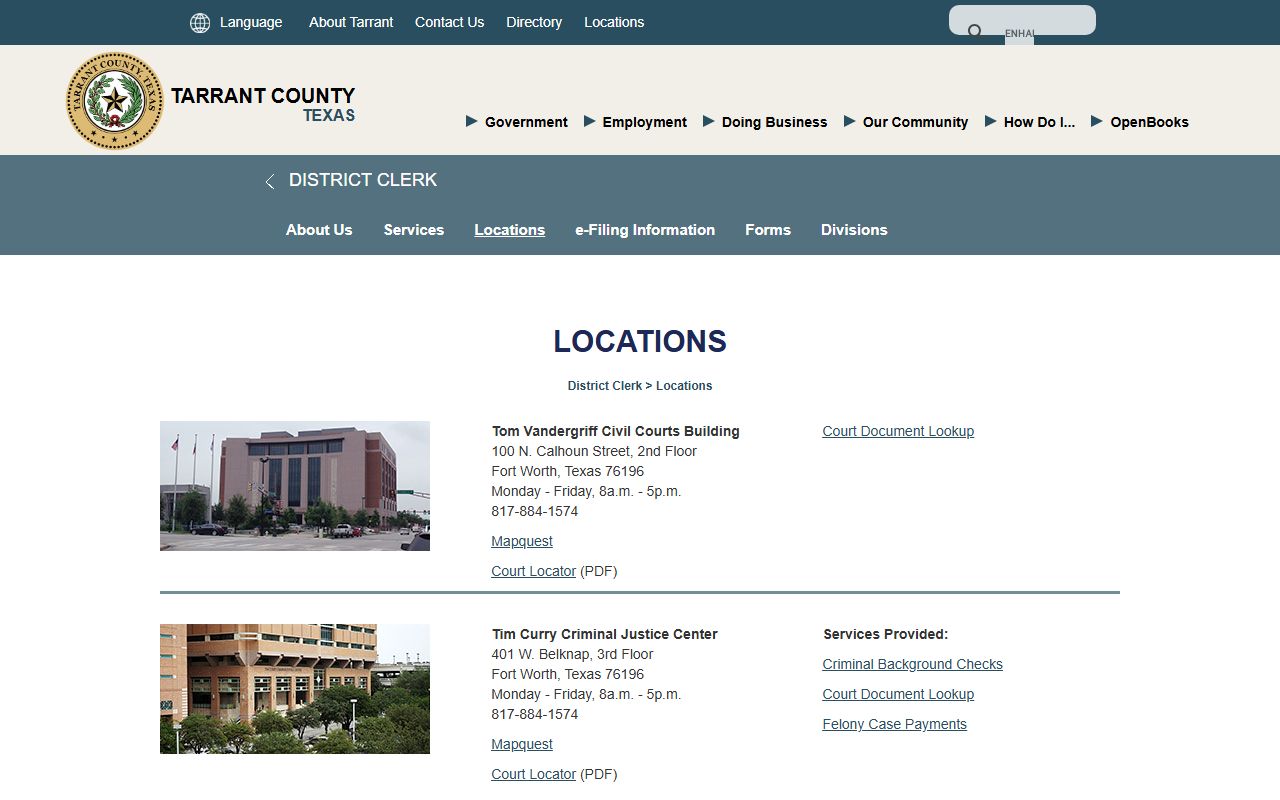
The page lists each office, its hours, and the phone line tied to Court Document Lookup at that building.
How to Request a Certified Copy
A certified copy is a copy the clerk stamps and signs as a true match to the official record. Courts, lenders, and government offices ask for certified copies because a plain printout is not proof. If you need a record for a legal proceeding, you need it certified. The District Clerk certifies copies of district court documents for $1 per page.
The process is short once you know the case. Follow these steps to get a certified copy from the office.
- Find the cause number. Use Court Document Lookup onsite, or the District Clerk public search, to locate the case and the exact document.
- Note the document type and the number of pages. The per-page fee is based on the full document.
- Go to the District Clerk office that holds the case, or contact it by phone or mail to ask for a certified copy.
- Pay the fee. Certified copies run $1 per page, and a clerk-performed search is $5 if you need help finding the file.
- Pick up the certified copy, or wait for it by mail if you requested it that way.
Note: A free onsite printout is fine for personal reference, but only a certified copy is accepted as proof in court or by a government agency.
Court Document Lookup Search Fields
When you search for a district court record, the public portal uses a small set of fields. You do not need to fill every one. A party name or a document number plus a date range covers most searches. The fields below come from the District Clerk public search layout.
| Field | Required | Notes |
|---|---|---|
| Department | No | Defaults to Warrants on the District Clerk portal |
| Search Term | No | Party name, document type, or document number |
| Date Range | No | From and to dates, based on the recorded date |
| Quick date filter | No | Buttons from Last 24 Hours through Last 1 Year |
| Search scope | No | Index Only, or Index and Full Text (OCR) |
For a deeper walkthrough of these portals and the fields they share with the County Clerk system, see the Tarrant County court records page.
Tarrant County District Clerk Fees
Viewing a record onsite through Court Document Lookup is free. Copies and clerk-run work cost money. Remote access from home or office is a paid subscription, not a free portal. The table lists the common District Clerk charges so you can plan before you ask.
| Item | Amount |
|---|---|
| Non-certified paper copy, per page | $1 |
| Non-certified electronic copy, 1 to 10 pages | $1 |
| Each electronic page after 10 | $0.10 |
| Certified copy, per page | $1 |
| Clerk-performed basic records search | $5 |
| Remote Court Document Lookup access | $120 setup, then $35 per month |
The free onsite lookup makes the most sense for a one-time need. The remote subscription fits attorneys and firms that pull district court files often. Note: confirm current charges with the clerk before paying, since some checkout fees can differ from posted copy rates.
Online and Remote Access
The District Clerk has a long technology record for a court office. It started remote lawsuit filing in 1995. In 2004 it added web-based access to images of court case documents. It opened public Court Document Lookup in 2010 and launched a new e-filing application on January 1, 2014. So most modern district filings exist as digital images you can pull.
For self-service from home, the office sells a remote Court Document Lookup subscription at $120 to set up and $35 per month. That access reaches the same civil, family, and felony criminal documents you would see at an onsite terminal. The free District Clerk public search indexes documents and warrants, and it is a good first stop to confirm a case exists before you pay for full document access.
Lawyers file new cases through the statewide eFileTexas system, which the county adopted in 2014. The public side of the office still centers on Court Document Lookup for viewing and copying existing files. For docket and hearing detail tied to these cases, the Tarrant County court dockets page explains how to read the running case list.