
About the Tarrant County County Clerk
Mary Louise Nicholson serves as the Tarrant County County Clerk. The office is one half of a split clerk system. Texas gives counties two elected clerks, and Tarrant County is no exception. The County Clerk handles the records tied to the County Courts at Law and the two Probate Courts. It also records most of the county's real property and keeps marriage licenses and vital records. The District Clerk, Thomas A. Wilder, keeps a different set of files. That office covers the district courts and felony criminal cases.
So what does the County Clerk actually do day to day? It records deeds and liens. It issues marriage licenses. It files wills and probate cases. It keeps county civil case records up to a set dollar limit. It also files assumed names, often called DBA filings. The office runs from the historic downtown courthouse, with branch sites at the criminal courts building, the vital records plaza, and several subcourthouses across the county.
The County Clerk publishes its services and contact points on the county site. You can confirm the right office and the right room before you go.
The county lays out the County Clerk's full role on its County Clerk page, which lists each division and its phone.
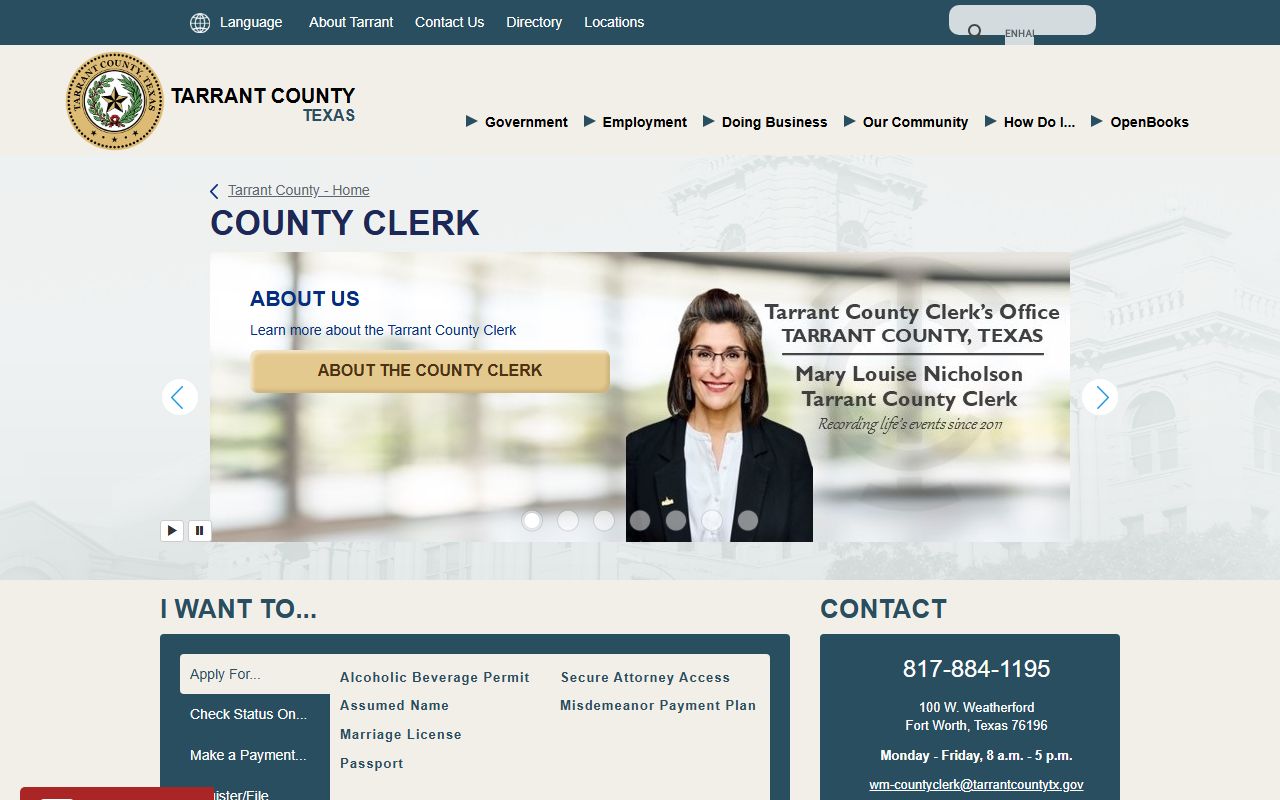
That page is the cleanest place to confirm which division handles your record before you pick a building or a portal.
Tarrant County County Clerk Locations
The County Clerk does not work out of one address. The main public records and civil court window sits in the 1895 Historic Courthouse downtown. County criminal court records sit in the Tim Curry building. Vital records, including marriage and birth and death records, sit at the Plaza Building. Match the record to the building before you drive in.
County Clerk
Clerk: Mary Louise Nicholson
1895 Historic Courthouse
100 W. Weatherford St.
Fort Worth, TX 76196
817-884-1195
Mon-Fri 8 a.m.-5 p.m.
County Criminal Courts
Tim Curry Criminal Justice Center
401 W. Belknap St., 2nd Floor
Fort Worth, TX 76196
817-884-1066
Mon-Fri 7:30 a.m.-5 p.m.
Vital Records
Tarrant County Plaza Building
200 Taylor St., 3rd Floor
Fort Worth, TX 76196
817-884-1550
Mon-Fri 8 a.m.-5 p.m.
The County Clerk also runs subcourthouses outside downtown, and many of them share the 817-884-1550 vital records line. You can apply for a marriage license or order copies at the Arlington Subcourthouse, the Gary Fickes Northeast Courthouse in Hurst, the J.D. Johnson Northwest Subcourthouse in Lake Worth, the Mansfield Subcourthouse, Southlake Town Hall, and the Dionne Phillips Bagsby Southwest Subcourthouse. The Charles F. Griffin Building and the G.K. Maenius Administration Building round out the list. Commissioners Court records sit at the Maenius building on 817-884-1237.
What the County Clerk Handles in Tarrant County
The County Clerk covers a broad mix of records. The office is the clerk of the three County Courts at Law, which take civil cases up to $250,000. Those cases include debt, breach of contract, garnishments, restraining orders, injunctions, auto and personal injury suits, and eminent domain matters. The office is also the clerk of the two Probate Courts. That covers estates, guardianships of incapacitated persons, mental health cases, and wills. On the records side, the County Clerk records real property and keeps marriage and vital records.
Here is the short list of what this office keeps.
- County Courts at Law records, civil cases up to $250,000.
- County criminal court records, which cover misdemeanors.
- Probate Court files, including wills, estates, and guardianships.
- Real property records such as deeds, deeds of trust, and liens.
- Marriage licenses and vital records like birth and death certificates.
- Assumed names, also called DBA or business name filings.
Felony criminal files and district civil and family files do not live here. Those sit with the Tarrant County District Clerk instead. If your case sounds like a felony or a divorce, start with that office.
The County Clerk and District Clerk Split
The split trips up a lot of people. Two clerks, two sets of files, one county. The County Clerk holds county-level cases, real property, marriage, probate, and assumed names. The District Clerk holds district-level cases. That means felony criminal, major civil, family, and juvenile files go to the District Clerk. A divorce decree, for example, comes from the District Clerk at the Family Law Center, not from the County Clerk's vital records desk.
Why does it matter? Because you can lose an hour searching the wrong portal. A marriage license is a County Clerk record. A divorce is a District Clerk record. Both touch the same couple, but they sit in different offices. The table below sorts the most common records by clerk so you can pick the right one fast.
| Record | Held By | Notes |
|---|---|---|
| Deeds and liens | County Clerk | Recorded in real property records |
| Marriage license | County Clerk | Applied for in person or by video |
| Probate and wills | County Clerk | Two Probate Courts |
| County civil up to $250,000 | County Clerk | County Courts at Law |
| Divorce decree | District Clerk | Family Law Center |
| Felony criminal | District Clerk | Criminal district courts |
Note: When a case sounds mid-size or like a misdemeanor, start with the County Clerk; when it sounds like a felony or a family matter, start with the District Clerk.
Tarrant County County Clerk Official Records Search
The County Clerk runs an Official Records Search portal for recorded and county records. You do not need to fill every field. A party name or a document number plus a date range will cover most searches. The portal showed records certified through 05/21/2026 on the date it was checked, and the banner notes that unofficial copies are free.
The civil courts division of the County Clerk explains which case types route to this office and how the records are kept.
The County Clerk's civil courts page spells out the County Courts at Law and Probate Court duties in plain terms.
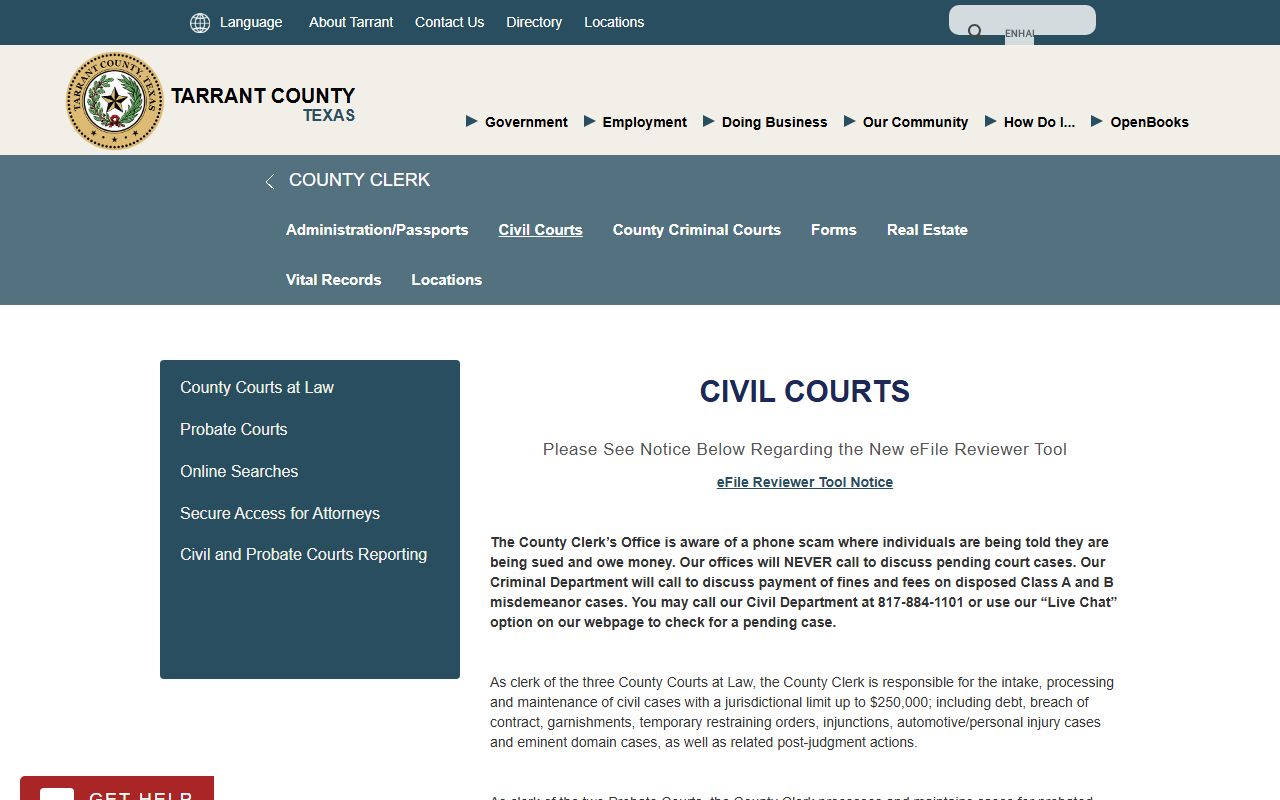
That page confirms the $250,000 civil ceiling and the probate scope before you choose a search field.
These are the fields you will see on the Official Records Search.
| Field Label | Type | Required | Notes / Format |
|---|---|---|---|
| Department | Dropdown | No | Real Property default; also Foreclosures, Marriage, Assumed Names |
| Search Term | Text | No | Grantor or grantee name, subdivision, document type, or document number |
| Date Range | Date range | No | From and to dates, based on recorded date |
| Quick date buttons | Buttons | No | Last 24 Hours through Last 1 Year |
| Search scope | Radio | No | Index Only, or Index and Full Text (OCR) |
Index Only searches the indexed fields. If you type two or more words, the system checks each word on its own. Index and Full Text reads the document contents, and it treats two or more words as a phrase.
Document Type Codes Used by the County Clerk
County Clerk records use short codes for document types. These codes help you filter a search or read a result. A deed shows as D. A judgment shows as J. A probate file shows as PROB, and a will shows as WILL. Marriage and business filings carry their own labels too.
The most common codes you will run into are below.
| Code | Document Type |
|---|---|
| D | Deed |
| DT | Deed of Trust |
| J | Judgment |
| L | Lien |
| PROB | Probate |
| WILL | Will |
| MARRIAGE LICENSE | Marriage license |
| ASSUMED NAME | Assumed name (DBA) |
Other codes show up too, like AFF for Affidavit, AOH for Affidavit of Heirship, GDN for Guardianship, POA for Power of Attorney, and PLAT for a recorded plat. Each result page also lists property fields such as legal description, parcel PIN, parties, property address, and return address.
How to Search Records or Request a Copy
Searching the County Clerk index is free, and viewing a record onsite is free. Certified copies and clerk-run searches cost money. Most people start online, confirm the document, then order a copy if they need one for a legal use. The steps below walk through a typical search and copy request.
- Open the County Clerk Official Records Search and pick the department that fits your record, such as Real Property or Marriage.
- Type a party name or a document number in the Search Term box.
- Set a date range, or click a quick date button like Last 1 Year.
- Choose Index Only for indexed fields, or Index and Full Text to read inside scanned documents.
- Open the result and confirm the names, dates, and document code match what you need.
- Order a certified copy at the counter, by mail, or through the approved copy process if you need it for court.
For a marriage record copy by mail, you give the full name of each applicant and the year of marriage. For a deed or lien, the document number or the party name plus a date range works best.
Tarrant County County Clerk Fees
Recording and copy charges follow a posted schedule. Most recorded documents cost a first-page fee plus a smaller fee for each added page. Marriage licenses, plats, liens, and UCC filings each carry their own rate. The table below lists the common County Clerk charges.
| Item | Amount |
|---|---|
| Real property recording, most documents | $20 first page + $4 each additional page |
| State lien | $12 |
| Federal lien | $25 |
| Plat 24 x 36 | $65 |
| Plat 18 x 24 | $50 |
| UCC standard, no attachment, one debtor | $30 |
| Marriage license | $76 |
| Marriage license with premarital certificate | $16 |
| Informal marriage declaration | $41 |
| Out-of-state applicant fee | $100 |
| Will for safekeeping | $5 |
| Small Estate Affidavit, new filing | $404 |
The county posts the recording and copy rates on its fee pages, which break out real estate, marriage, and probate charges.
You can confirm the recording rates on the real estate records fee schedule before you mail or record a document.
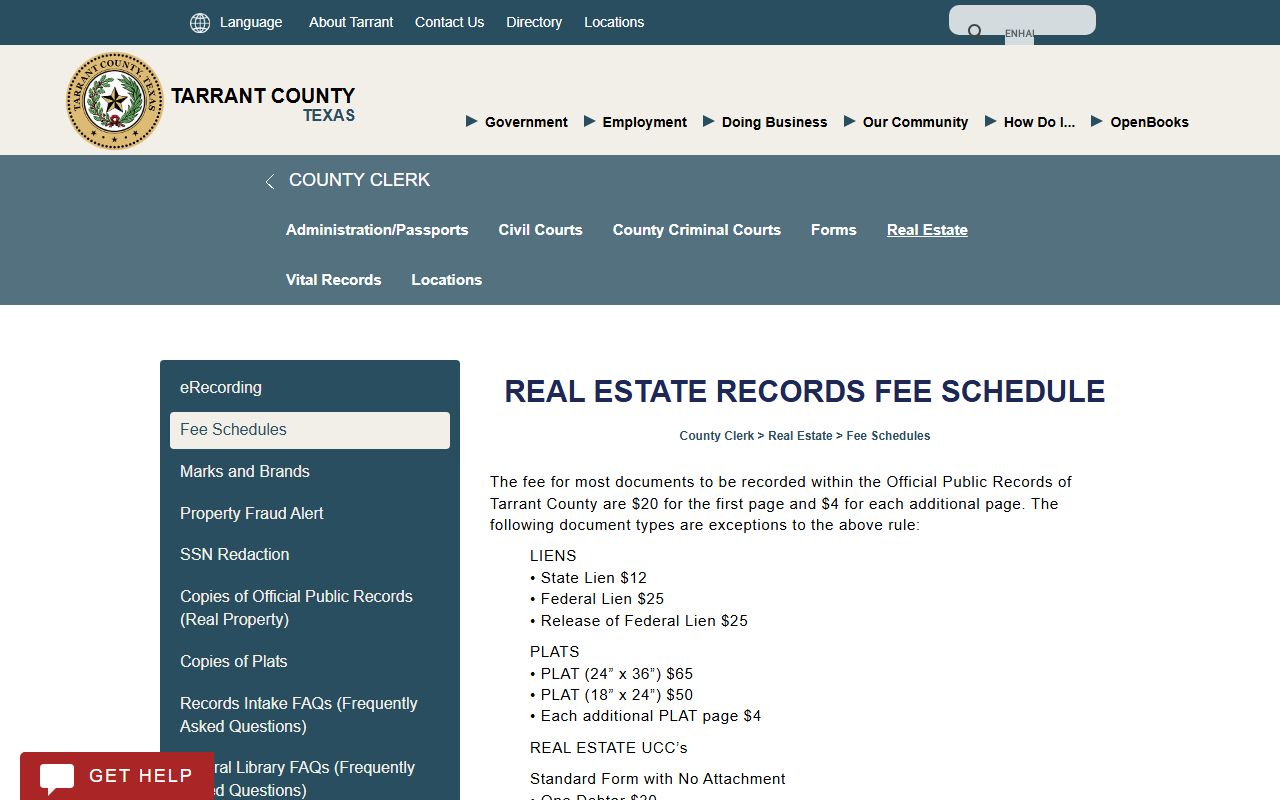
The posted schedule is the safest source, since checkout and certification fees can differ from the plain copy rate.
Note: Confirm current charges with the County Clerk before you pay, since certification fees and credit card surcharges can change the final total.
Marriage Licenses Through the County Clerk
Marriage licenses come from the County Clerk, not the District Clerk. Texas offers two paths. One is the formal marriage license. The other is the declaration of an informal, or common law, marriage. A formal license can come from any Texas county and be used anywhere in the state. Both parties must be at least 18, and both must show valid government photo ID.
There are a few rules worth knowing before you apply. Names on the license must match the ID exactly. Applicants must know their Social Security number. A 72-hour waiting period applies after issuance, with waivers for active-duty military or a valid premarital education certificate. The marriage must happen within 90 days. Divorced applicants wait 30 days after a divorce is final unless that wait is waived.
For divorce decrees, applications, and certified copies, see the marriage and divorce records page, since the divorce side runs through the District Clerk.
Probate and Wills at the County Clerk
The County Clerk processes probate for the two Probate Courts. That covers estates, guardianships of incapacitated persons, mental health cases, and wills. Probate case wills are filed with the County Clerk probate office in Room 233 at 100 W. Weatherford St. You give the assigned case number when you file the will. For will safekeeping only, you bring the will to the Intake office in Room B90, and the safekeeping fee is $5.
An Affidavit of Heirship is not filed with the Probate Courts. It is filed in the County Clerk Official Public Records Office in Room B20. A new Small Estate Affidavit filing costs $404. For deeper detail on estates, guardianship, and the probate process, see the probate records page.
County Clerk Forms Library
The County Clerk posts a set of fillable forms on its site. These cover identity proof, vital records searches, assumed names, and military discharge records. The forms have editable fields, but some browser security settings make you download the file first and open it directly.
The most-used County Clerk forms include the following.
- Affidavit of Proof of Identity.
- Application for Search and Certificate of Birth or Death Records, in English and Spanish.
- Assumed Name Application, both incorporated and unincorporated.
- Marriage Information Form.
- Military Discharge Request and the removal request form.
You can find every current form on the County Clerk forms page, which keeps the editable PDFs in one place.
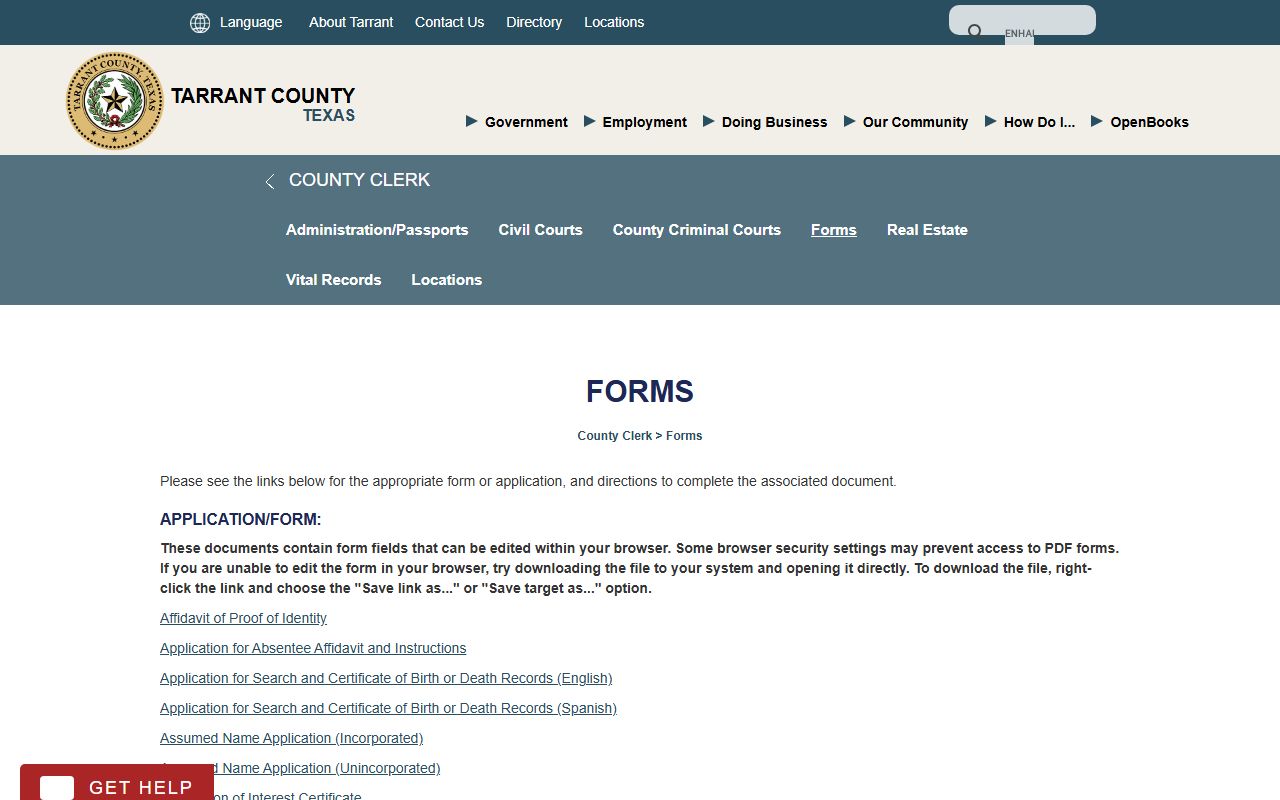
Downloading the form first is the simplest fix if the fields will not fill inside your browser.