
Tarrant County District Courts Overview
In Texas, district courts are the trial courts of general jurisdiction. That means they can hear almost any kind of case. They take felony criminal cases, large civil disputes, divorce and family matters, and juvenile cases. There is no fixed dollar ceiling on the civil cases they hear. This puts them at the top of the trial-court layer, above the County Courts at Law and the Justice of the Peace courts. Most major cases in the county start here.
Tarrant County does not run one big district court. It runs many, and a lot of them specialize. Felony criminal courts sit in one building. Civil district courts sit in another. Family courts work out of a third, and a juvenile court works from a fourth. The District Clerk, Thomas A. Wilder, keeps the records for all of these courts. His office supports 28 elected courts plus 22 associate judges and magistrates, and takes in more than 61,000 new case files a year.
The Texas Judicial Branch lays out this trial-court role on its trial courts page, which explains what district courts can hear statewide.
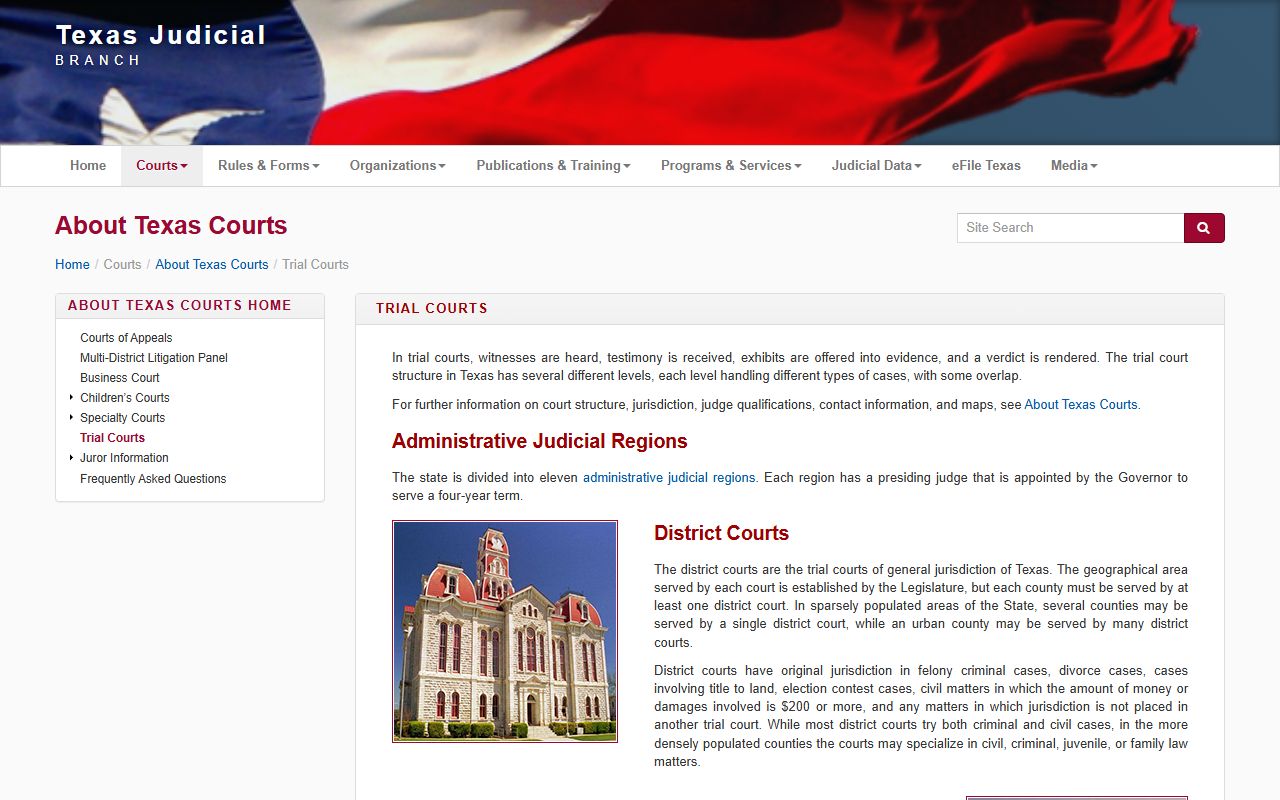
The state page is a good first stop to confirm that a district court, and not a lower court, is the right venue for a case.
List of Tarrant County District Courts
The county splits its district courts by case type, and the building tells you the type. Criminal district courts sit at the Tim Curry Criminal Justice Center on West Belknap. Civil district courts sit at the Tom Vandergriff Civil Courts Building on North Calhoun. Family district courts work from the Family Law Center on East Weatherford, and the juvenile district court works from the Scott D. Moore Juvenile Justice Center. The table below lists each numbered court, its building, and a phone where the county published one. Where the official list did not show a direct phone, the field is left blank.
| Court | Building | Phone |
|---|---|---|
| Criminal District Court No. 1 | Tim Curry Justice Center, 5th Floor, 401 W. Belknap | |
| Criminal District Court No. 2 | Tim Curry Justice Center, 6th Floor, 401 W. Belknap | |
| Criminal District Court No. 3 | Tim Curry Justice Center, 7th Floor, 401 W. Belknap | |
| Criminal District Court No. 4 | Tim Curry Justice Center, 8th Floor, 401 W. Belknap | |
| 213th District Court | Tim Curry Justice Center, 5th Floor, 401 W. Belknap | |
| 297th District Court | Tim Curry Justice Center, 5th Floor, 401 W. Belknap | |
| 371st District Court | Tim Curry Justice Center, 5th Floor, 401 W. Belknap | |
| 372nd District Court | Tim Curry Justice Center, 6th Floor, 401 W. Belknap | |
| 396th District Court | Tim Curry Justice Center, 6th Floor, 401 W. Belknap | |
| 432nd District Court | Tim Curry Justice Center, 6th Floor, 401 W. Belknap | |
| 485th District Court | Tim Curry Justice Center, 8th Floor, 401 W. Belknap | |
| 17th District Court | Tom Vandergriff Civil Courts Building, 3rd Floor, 100 N. Calhoun | 817-884-1460 |
| 48th District Court | Tom Vandergriff Civil Courts Building, 4th Floor, 100 N. Calhoun | 817-884-2690 |
| 67th District Court | Tom Vandergriff Civil Courts Building, 4th Floor, 100 N. Calhoun | 817-884-1452 |
| 96th District Court | Tom Vandergriff Civil Courts Building, 4th Floor, 100 N. Calhoun | 817-884-1450 |
| 141st District Court | Tom Vandergriff Civil Courts Building, 3rd Floor, 100 N. Calhoun | 817-884-1992 |
| 153rd District Court | Tom Vandergriff Civil Courts Building, 3rd Floor, 100 N. Calhoun | 817-884-2691 |
| 236th District Court | Tom Vandergriff Civil Courts Building, 5th Floor, 100 N. Calhoun | 817-884-1709 |
| 342nd District Court | Tom Vandergriff Civil Courts Building, 5th Floor, 100 N. Calhoun | 817-884-2710 |
| 348th District Court | Tom Vandergriff Civil Courts Building, 3rd Floor, 100 N. Calhoun | 817-884-2715 |
| 352nd District Court | Tom Vandergriff Civil Courts Building, 4th Floor, 100 N. Calhoun | 817-884-2730 |
| 231st District Court | Family Law Center, 5th Floor, 200 E. Weatherford | |
| 233rd District Court | Family Law Center, 5th Floor, 200 E. Weatherford | |
| 322nd District Court | Family Law Center, 4th Floor, 200 E. Weatherford | |
| 324th District Court | Family Law Center, 4th Floor, 200 E. Weatherford | |
| 325th District Court | Family Law Center, 5th Floor, 200 E. Weatherford | |
| 360th District Court | Family Law Center, 4th Floor, 200 E. Weatherford | |
| 323rd District Court | Scott D. Moore Juvenile Justice Center, 2701 Kimbo Road |
The county keeps the master roster on its district courts page, which is the source for these floors and addresses.
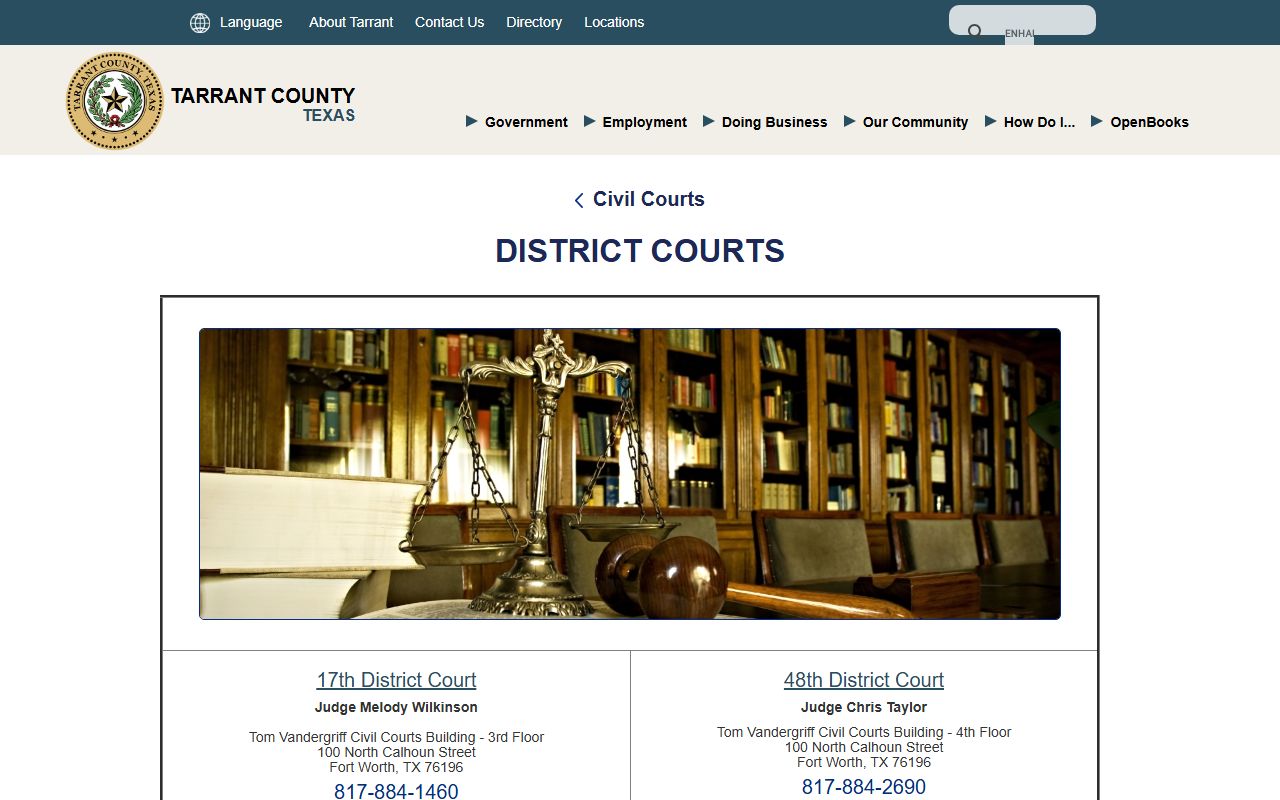
The official roster is worth a quick check before any visit, since judges, floors, and phone lines can change between elections.
Civil, Family, Criminal, and Juvenile Courts
Each group of district courts handles its own kind of case. Knowing the group tells you the building and the right clerk window. Here is what each one covers in Tarrant County.
- Civil district courts hear large lawsuits, contract disputes, injury claims, tax suits, and injunctions. These sit at the Tom Vandergriff Civil Courts Building.
- Criminal district courts hear felony prosecutions, from indictment through trial and sentencing. These sit at the Tim Curry Criminal Justice Center.
- Family district courts hear divorce, custody, child support, and protective orders. These work from the Family Law Center.
- Juvenile district court handles cases involving minors and works from the Scott D. Moore Juvenile Justice Center.
The District Clerk keeps the file for every one of these courts. So a felony judgment, a civil petition, and a divorce decree all run through the same elected office, just at different buildings. If you want the case file or a certified copy, that is the office to ask. You can read more about its role on the District Clerk page.
District Court vs County Court vs Justice Court
Texas stacks its trial courts by case size and seriousness. District courts take the biggest and most serious matters. County Courts at Law take a middle tier of civil cases and misdemeanors. Justice of the Peace courts handle the smallest claims and many citations. The table compares the three on the points that matter most when you are trying to find a record.
| District Court | County Court at Law | Justice / JP Court | |
|---|---|---|---|
| Civil Limit | No fixed ceiling | Up to $250,000 | Up to $20,000 |
| Main Case Types | Felony, major civil, family, juvenile | Mid-size civil, misdemeanor, probate | Small claims, evictions, Class C citations |
| Family Cases | Yes | No | No |
| Recordkeeper | District Clerk | County Clerk | JP court |
This split is why a felony and a small-claims case in the same county end up with different clerks. The District Clerk keeps the felony file. The County Clerk keeps County Court at Law and probate files, and you can find that office on the County Clerk page. The JP court keeps its own small-claims and citation records.
How a Case Moves Through the System
A case can climb the ladder. It often starts in a lower court and moves up on appeal. The path depends on whether the matter is civil or criminal. Most Tarrant County trial-court appeals go to the Second Court of Appeals in Fort Worth first. From there, civil and juvenile matters can reach the Supreme Court of Texas, while criminal matters go to the Texas Court of Criminal Appeals.
Case flow: Justice Court › County Court at Law › District Court › Court of Appeals › Texas Supreme Court or Court of Criminal Appeals
Inside a single court, a case follows its own steps from filing to judgment. The criminal and civil paths look a little different, but both end with a judgment that a party can appeal.
- Criminal: Arrest, then a magistrate first appearance, then indictment, arraignment, pretrial, trial, sentencing, and appeal.
- Civil: A petition is filed, the other side answers, discovery and mediation follow, then trial, judgment, and appeal.
For the running list of hearings and filings in a case, the court dockets page explains how to read a docket.
Appeals to the Second Court of Appeals
The Second Court of Appeals sits in Fort Worth and hears most appeals from Tarrant County district and county courts. It is an intermediate court. That means it reviews what the trial court did, but it is not the last word. Civil and juvenile appeals can move on to the Supreme Court of Texas. Criminal appeals move on to the Court of Criminal Appeals, which has the final say on criminal matters in the state.
The intermediate courts of appeals are spread across the state by region. The First through Fourteenth Courts have regional civil and criminal appellate jurisdiction over district and county courts. A newer Fifteenth Court of Appeals carries statewide civil jurisdiction for certain state and business-court matters.
The Texas Judicial Branch describes the appellate layer on its courts of appeals page.
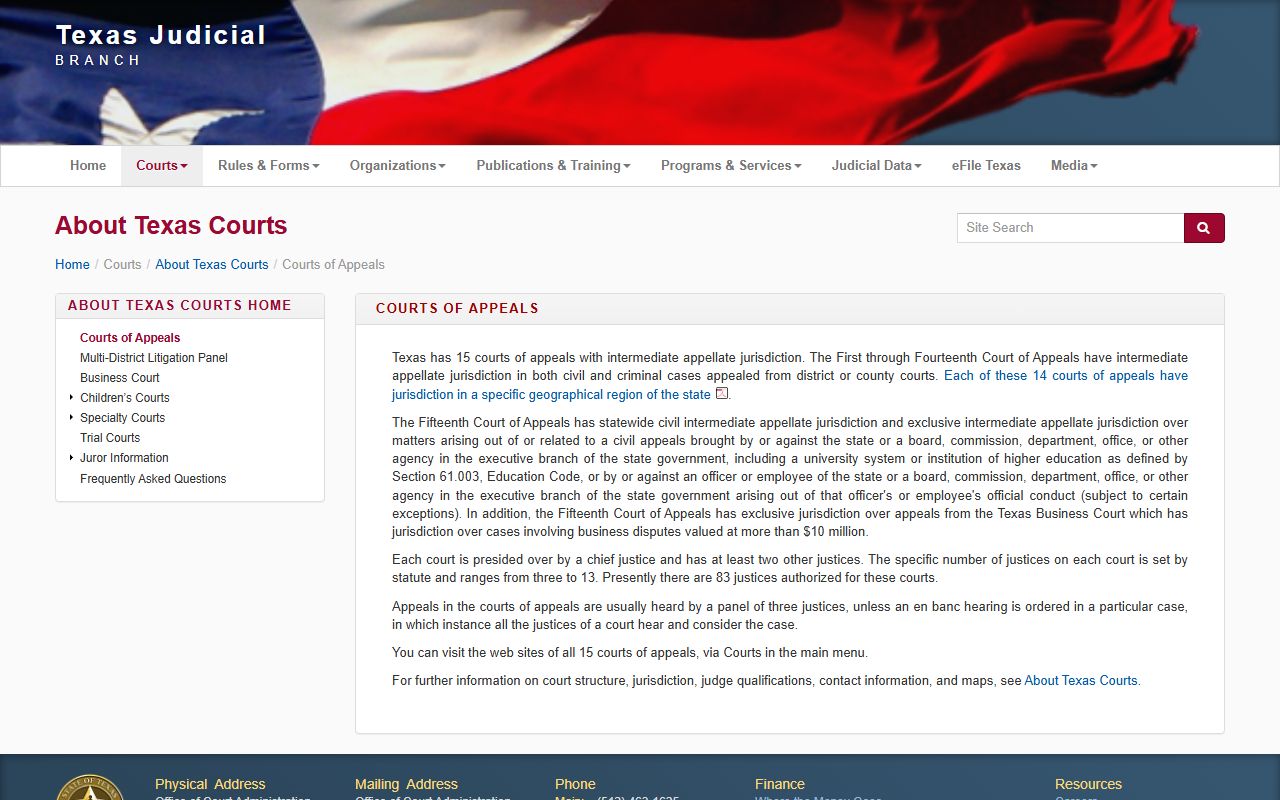
The page confirms which appellate court reviews a Tarrant County district court ruling and what comes next after that.
County Courts at Law in Tarrant County
County Courts at Law sit one step below the district courts. They take civil cases up to $250,000, along with misdemeanors and probate work. The County Clerk, Mary Louise Nicholson, keeps records for these courts, not the District Clerk. The county runs three of them, each with its own judge and room at the courthouse.
| Court | Judge | Phone |
|---|---|---|
| County Court at Law No. 1 | Don Pierson | 817-884-1457 |
| County Court at Law No. 2 | Jennifer Rymell | 817-884-1813 |
| County Court at Law No. 3 | Mike Hrabal | 817-884-1914 |
All three sit at the Tarrant County Courthouse at 100 W. Weatherford in Fort Worth. The County Clerk is also clerk of the two Probate Courts, which handle estates, guardianships, and wills.
Magistrate and Justice Courts
Below the district and county courts sit the Justice of the Peace courts. Tarrant County has eight of them. They are the local people's court for small civil claims, evictions, repair-and-remedy cases, truancy, and many Class C misdemeanor citations. Their civil limit is $20,000. A party can appeal a JP ruling up to a county-level court.
The District Clerk also serves as Magistrate Clerk for the county. Magistrate functions cover the first appearance after an arrest, where a judge sets bail and reads rights. The office handles roughly 60,000 magistrate cases a year on top of its regular district court caseload. City municipal courts round out the lower layer, handling city ordinance violations and city traffic tickets.
For tickets and citations, the traffic court records page covers how JP and municipal traffic cases are filed and searched.
Finding Tarrant County District Court Records
District court files are public for most case types. The District Clerk runs a Court Document Lookup service that pulls civil, family, and felony criminal cases filed with the office. It is free as a self-service tool onsite. A clerk-performed basic search costs $5, and certified copies run $1 per page. Remote access from home carries a setup fee and a monthly charge.
Some district court records are sealed or confidential. Juvenile records are restricted. Adoption records are sealed. Expunged records are removed from public view. For sealed files, you usually need to be a party, an attorney of record, or someone the court allows by order.
To look up a case or order a copy, start with the court records page, which walks through the District Clerk portal and what each result shows.
Note: Match the case type to the right building and clerk before you search, since a felony file and a divorce file live at different downtown addresses.