
Getting a Marriage License in Tarrant County
Marriage licenses in Tarrant County come from the County Clerk. The current clerk is Mary Louise Nicholson. Her office issues the license, logs it, and keeps the record after the ceremony. Divorce decrees do not come from this office. Those sit with the District Clerk, which is a key point that comes up again later on this page.
Texas offers two paths to marry. The first is a Formal Marriage License. The second is a Declaration and Registration of an Informal Marriage, often called common law. A formal license can be issued by any Texas county and used anywhere in the state. If the wedding happens outside Texas, check the rules for that place before you rely on a Texas license. Most couples take the formal route.
Both parties must be at least 18. Each person needs a valid government photo ID, such as a driver license, state ID card, passport, military ID, or visa. The names printed on the license match the ID exactly, so the clerk cannot change a spelling. Each applicant must know their Social Security number. A blood test is not required in Texas. These rules come straight from the county's marriage license page, which lays out the ID and residency details.
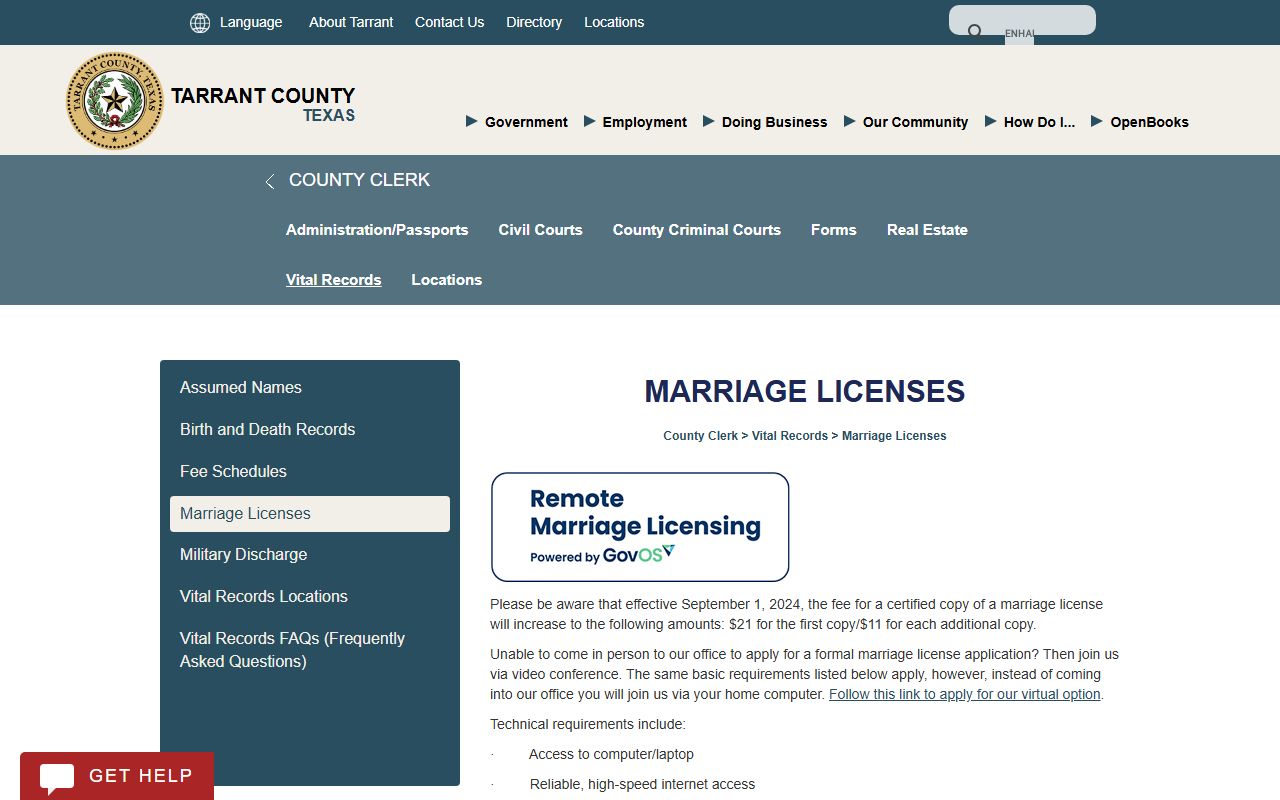
That page also explains who can appear by video and what proof of residency looks like, which sets up the fee and waiting rules below.
How to Apply for a Marriage License
The process is short when you bring the right items. Both people normally appear together. Formal applicants may use a video conference instead of showing up in person, and an Affidavit of Age and Identity is required for that remote option. Informal marriage applicants must both appear in person, with no absentee or video option. Fill out the online application first if you want to save time at the counter.
- Fill and save the online application if you want a head start before you arrive.
- Appear together at the downtown clerk's office or a subcourthouse, or use the video conference if you qualify for a formal license.
- Present a valid photo ID and confirm your Social Security number for each applicant.
- Show proof of Texas residency to avoid the out-of-state fee, if it applies to you.
- Pay the fee by cash or card. Cards accepted include Visa, Mastercard, American Express, and Discover.
- Wait 72 hours after the license is issued, unless a waiver applies to your situation.
- Hold the ceremony within 90 days of the issue date.
After the wedding, the officiant returns the completed license within 30 days. It goes back to the County Clerk at 200 Taylor Street, Suite 301, in Fort Worth. Only then does the marriage become part of the permanent record you can later request a copy of.
Marriage License Application Fields
The application asks for a set of facts about each person. Most are simple identity items. A few only apply in certain cases, such as a recent divorce or a claim for a reduced fee. The table below lists what you give and when it matters. Names must match your ID, so double-check spelling before you sign.
| Field | Required | Notes |
|---|---|---|
| Full legal name | Yes | Must match the photo ID exactly; the clerk cannot change spelling |
| Government photo ID type and number | Yes | Driver license, state ID, passport, military ID, or visa |
| Date of birth / age | Yes | Both parties must be at least 18 |
| Social Security number | Yes | You must know it; no blood test is required |
| Texas residency proof | No | Needed only to avoid the $100 out-of-state fee |
| Prior divorce date | If applies | A certified waiver is needed if the divorce was under 30 days ago |
| Twogether certificate | If applies | Lowers the fee and can waive the 72-hour wait |
| Affidavit of Age and Identity | If applies | Required for video-conference formal applications |
| Absentee affidavit | If applies | Used when one formal applicant cannot appear |
An informal marriage declaration is a little different. Both parties state they agreed to be married, lived together in Texas as a married couple, and told others they were married. No absentee affidavit is allowed for informal marriage, and applicants under 18 cannot file one. Residency proof in the county includes things like a driver license, vehicle registration, voter card, utility bills, or a property tax statement. PO Box addresses are not accepted.
Tarrant County Marriage and Divorce Fees
Marriage license fees in Tarrant County are set by the County Clerk. The amount depends on the license type and whether both people prove Texas residency. A premarital education certificate, the Twogether in Texas course, lowers the cost a lot. Card payments add a small processing fee on top. The county posts the full list on its vital records fee schedule.
| Item | Amount |
|---|---|
| Formal marriage license | $76 |
| Formal license with Twogether certificate | $16 |
| Informal marriage declaration | $41 |
| Out-of-state applicant fee (neither proves Texas residency) | $100 |
| Credit card processing | 1.73% added |
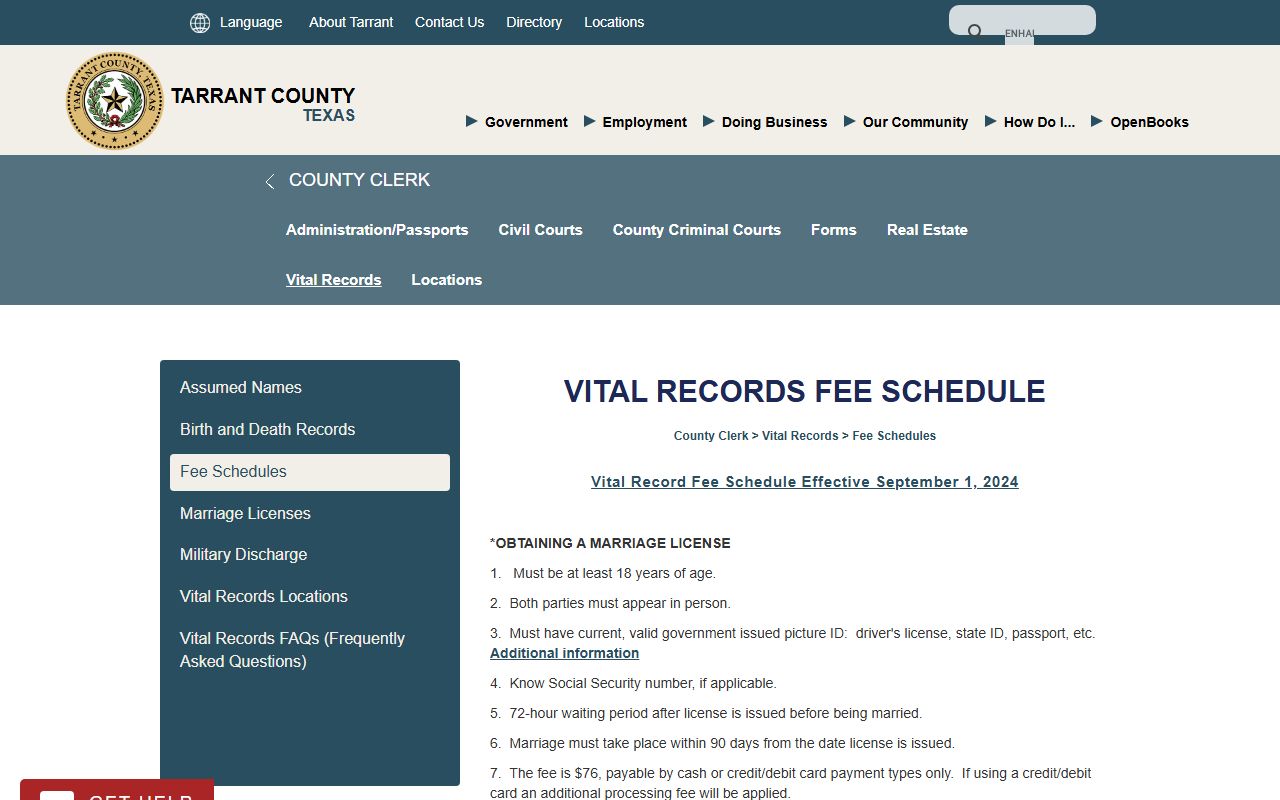
The fee page is the right place to confirm the current charge before you pay, since the Twogether discount and the out-of-state fee can change the total a lot.
Divorce fees work on a separate track. The District Clerk sets divorce filing costs, not the County Clerk, and a divorce decree copy is requested from the District Clerk too. Filing fees vary by case type and county schedule. People who cannot afford the cost may file a Statement of Inability to Afford Payment with the court instead of paying up front.
How to Look Up Tarrant County Marriage Records
A marriage copy request needs three things. You give the full name of the groom, the full name of the bride at the time of application, and the year of the marriage. Without the year, the search gets much harder. The County Clerk handles these requests by mail, by phone, and through an approved online partner.
To request by mail, send your request to the Tarrant County Clerk's Office at 200 Taylor Street, Suite 301, in Fort Worth. The official pages list both 76102 and 76196 as the ZIP, so confirm the current ZIP before you mail anything. By phone, the marriage records line is 817-884-1550. For a faster route, certified copies can be ordered through VitalChek, the County Clerk's approved official internet business partner. Subcourthouse locations also handle marriage license business across the county.
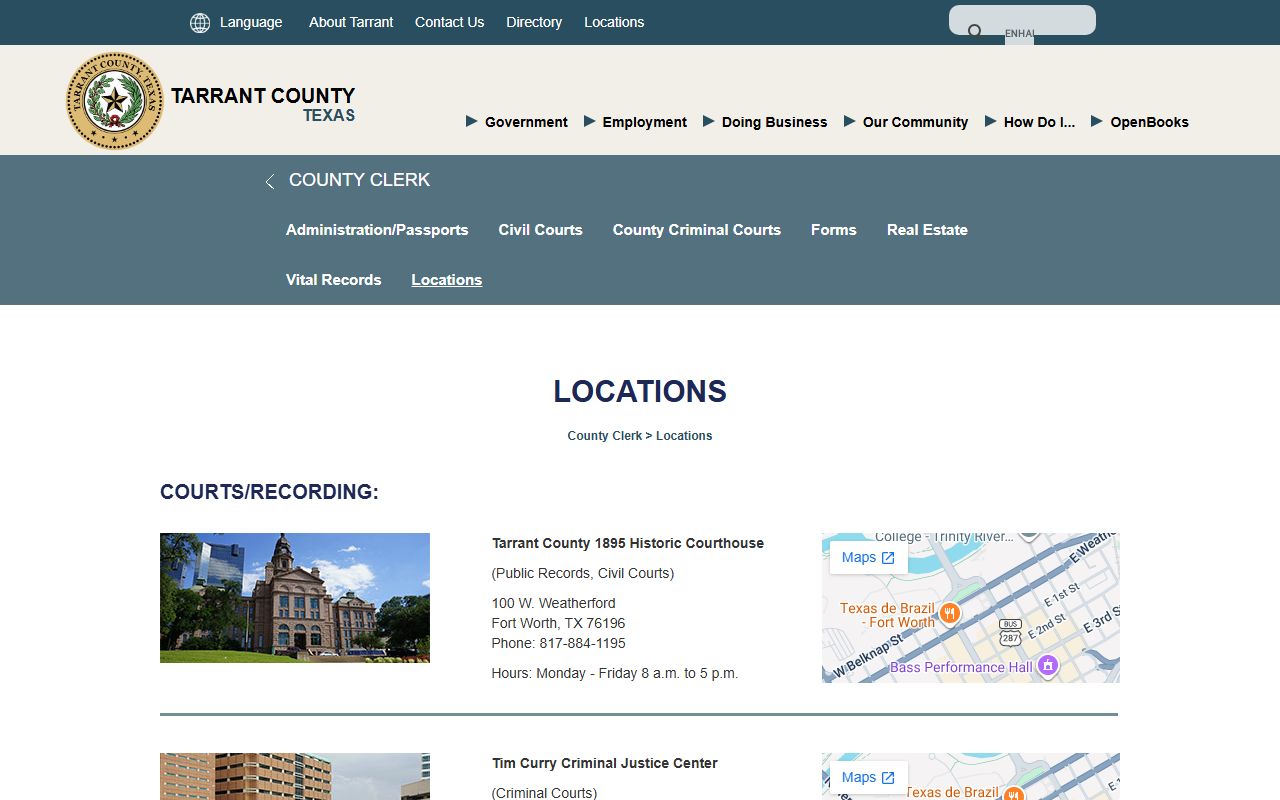
The locations page lists the downtown office and the subcourthouses, so you can pick the office closest to you for in-person help.
Old records sit in a special place. Tarrant County Archives holds many original marriage licenses more than 100 years old. Volunteers are building a pre-1912 license database by cross-checking names against transcribed record books. Licenses on view begin around 1875. There is a gap, though. Records made before March 29, 1876 were destroyed in a courthouse fire, so very early marriage records are scarce. Genealogy searchers run into that gap often.
How to Find Tarrant County Divorce Records
Divorce is a family district court matter. The District Clerk holds the files, and the work happens at the Family Law Center, not at vital records. The clerk for that office is Thomas A. Wilder. If you ask the County Clerk for a divorce decree, you will be sent to the right place, but you can skip the detour by going to the District Clerk first.
District Clerk Family Law Center
200 E. Weatherford St., 3rd Floor
Fort Worth, TX 76196
817-884-1265
Texas allows a no-fault divorce based on insupportability. It also allows fault grounds such as cruelty or adultery under the Family Code. A typical case file holds the Original Petition for Divorce, a civil case information sheet if required, a waiver or answer, any temporary orders, a parenting plan and child support forms when children are involved, and the final decree. The decree is the document most people are after.
Divorce records are public unless a court seals or restricts them. But sensitive parts get redacted. Child details, financial account data, protective-order content, and personal identifiers are limited or removed. Adoption records tied to a family case are sealed under Texas law, so they are not open to the public the way a basic decree is.
Texas Family Code Chapter 162 sets the confidentiality rules for adoption, which is why those files stay closed even when other family records are open.
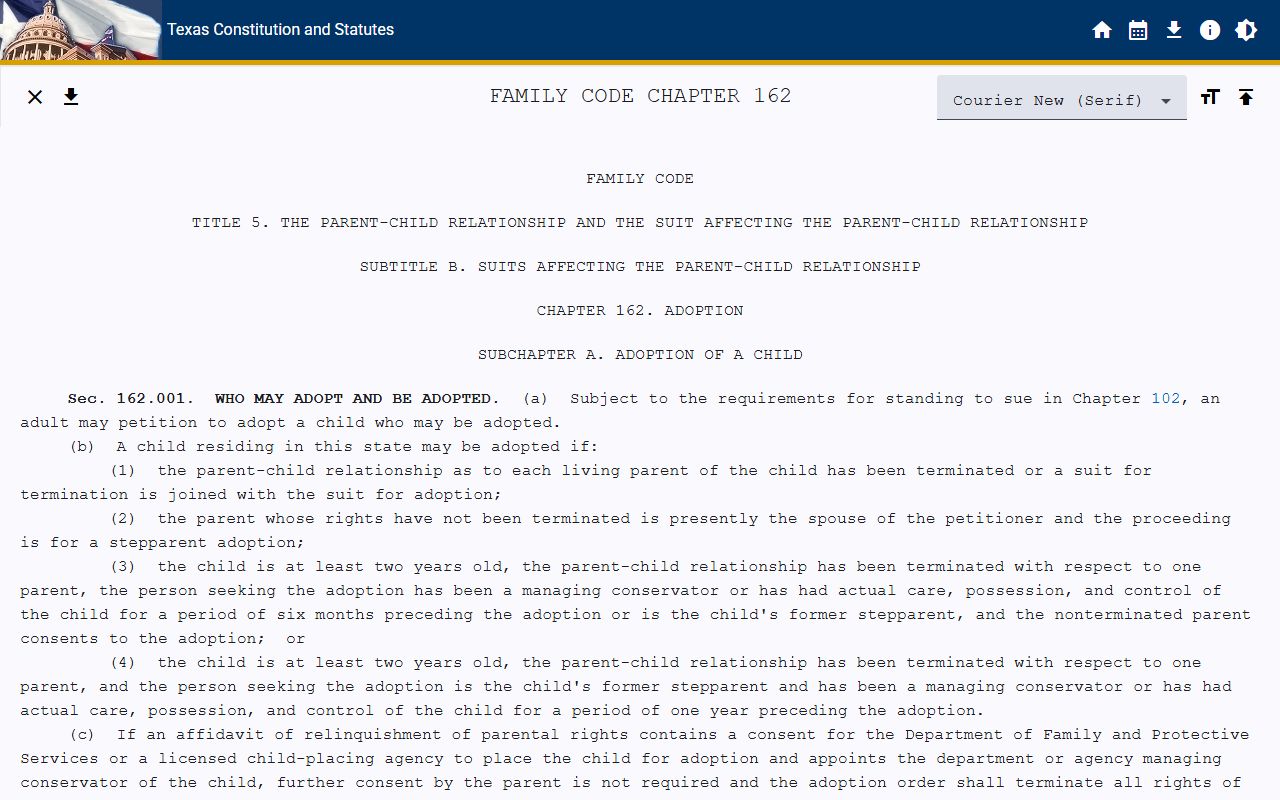
The statute makes clear that adoption files carry a higher level of privacy than a standard divorce decree, so plan your request around what is actually open.
How to File for Divorce in Tarrant County
Filing for divorce follows a set order. You start by confirming you can file here. Texas generally asks for six months of state residency and 90 days in the county before filing, though you should verify the current Family Code rule for your case. Once venue is set, the rest of the steps move through the District Clerk.
- Confirm Texas residency and Tarrant County venue before you file.
- Prepare the Original Petition for Divorce and any required family forms.
- File with the District Clerk through eFileTexas, or in person if the court allows it.
- Pay the filing fee, or submit a Statement of Inability to Afford Payment.
- Serve the other party, or obtain a valid signed waiver of service.
- Attend any temporary and final hearings the court sets.
- Submit the final decree, plus child support and custody orders if children are involved.
- Request certified copies from the District Clerk after the judge signs the decree.
Note: A newly divorced person must wait 30 days after the divorce is final before remarrying, unless a judge waives that wait and a certified copy of the waiver is shown at purchase.
Getting Certified Copies
There are two kinds of copies, and they are not the same. A plain copy is fine to read and confirm a fact. A certified copy carries the clerk's seal and is the one courts, banks, and agencies accept for legal use. If you need to prove a marriage or a divorce for a name change, a benefit, or an immigration matter, get the certified version.
For marriage, the certified copy comes from the County Clerk or through VitalChek. You give the groom name, the bride name as listed at application, and the marriage year. For divorce, the certified decree comes from the District Clerk at the Family Law Center after the judge signs it. Processing time depends on the method. Mail and online orders take longer than walking into the office. Plan ahead if a deadline is close.
Texas Vital Records Office
The state keeps a central index too. The Texas Department of State Health Services runs the Vital Statistics unit. For marriage and divorce, the state holds an index that confirms a record exists and points you to the county that has it. The actual certified marriage copy still comes from the County Clerk, and the divorce decree still comes from the District Clerk. Use the state office to verify, then order from the county.
The state index is handy when you do not know which county logged a marriage, since you can confirm the record before you contact a clerk.