
Tarrant County Jail Roster Overview
Sheriff Bill E. Waybourn runs the Tarrant County Sheriff's Office and the Detention Bureau. The Sheriff's online inmate search is the jail roster. It draws from the same county booking system that intake staff use, so it reflects active custody as the data is entered. The roster lists people held in the county jail system. You can search it for free, day or night, without an account. Most people use it to confirm an arrest, find a custody ID, or check whether someone is still inside.
The Sheriff page is the front door for all of this. It links to the inmate search, daily booked-in reports, daily bond reports, money deposits, inmate correspondence, and health services. The Sheriff's published inmate search portal is the cleanest place to begin a lookup.
The lead-in for the roster sits on the official Tarrant County inmate search site, which opens the jail roster lookup. The screen below shows the search form you start from.
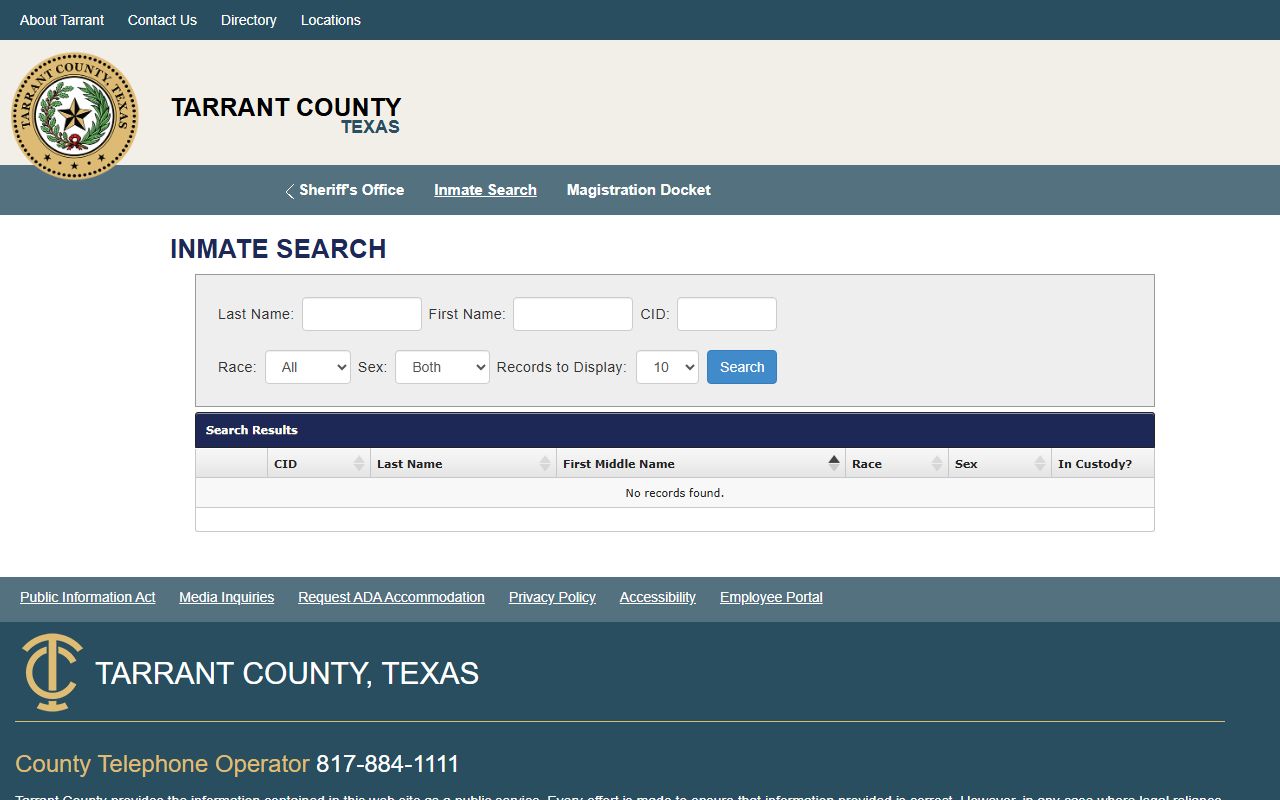
From this one form you can run a name search, a custody ID search, or a filtered search by race and sex.
One thing to keep clear. The county roster shows county jail custody. It does not show people sent to the Texas prison system, and it does not show federal detainees. If your person was sent to state prison, you check a state database instead. If the case was federal, you check the federal locator. Both of those are covered further down.
How to Use the Tarrant County Inmate Roster
The roster is built for quick name lookups. You do not need a custody ID to start. A last name alone often pulls a list, and you narrow from there. The Sheriff also keeps a second page for court appearances, called the magistration docket, which lists people scheduled to see a magistrate after booking. Walk through the roster like this.
- Open the jail roster lookup on the Sheriff's inmate search site.
- Type a last name. Add a first name or a CID to narrow the list if you get too many hits.
- Set the Race and Sex filters only if you need them, then pick how many records to show.
- Click Search and scan the result rows for the right name and custody status.
- Click the detail link on a row to open that person's booking profile.
- To check a court date after booking, open the magistration docket from the same site.
If a name does not appear, try the last name by itself and check the spelling. Booking can lag a short while, so a very recent arrest may not show right away. The Sheriff's official inmate page explains the tool and the rules behind it.
You can reach that explainer through the Sheriff's inmate search information page, which sits inside the county government site. The view below shows how the county frames the lookup.
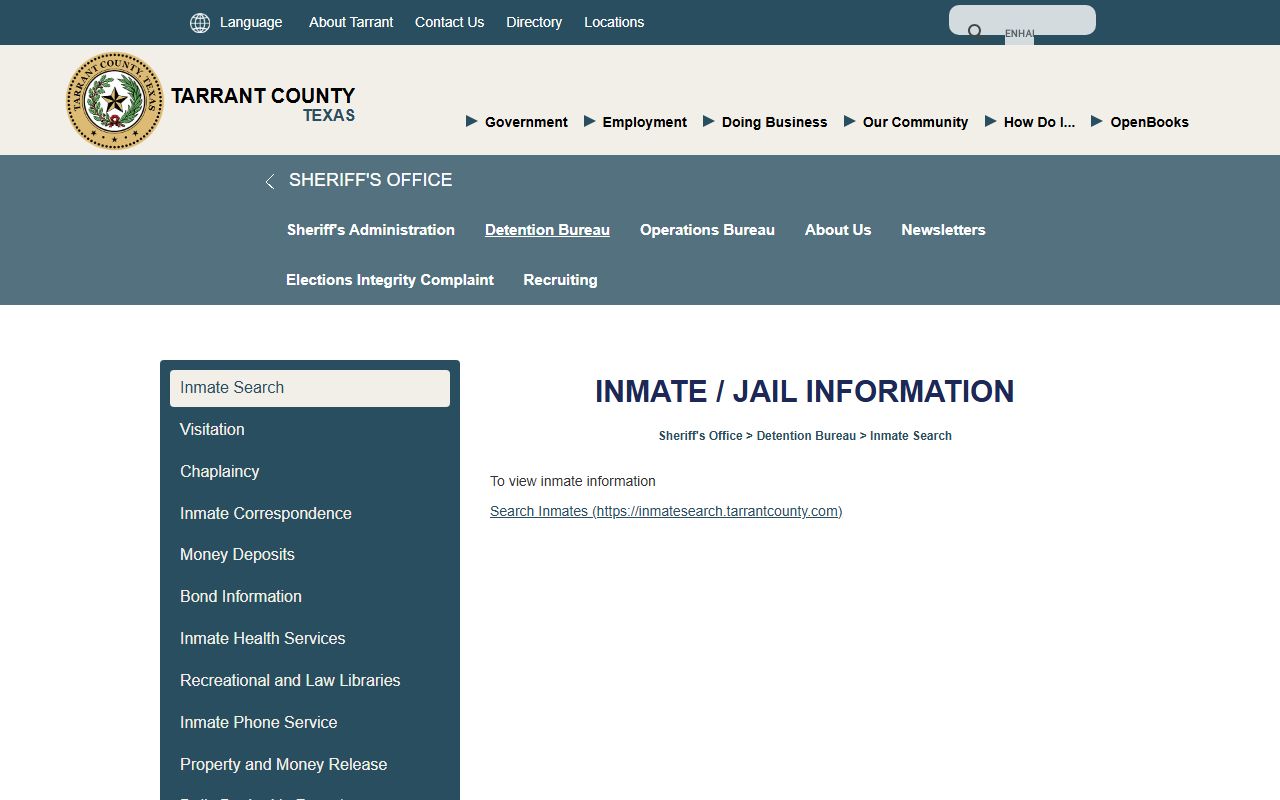
Reading that page first helps you know what the roster will and will not tell you before you search.
Roster Search Fields
The jail roster form keeps its fields short. None of them are strictly required, so you can search on just one. A last name is the most common entry. The CID field is the fastest path when you already have a custody ID. Two dropdowns let you filter by race and sex, and a third sets how many rows come back per page.
| Field Label | Type | Required | Notes / Options |
|---|---|---|---|
| Last Name | Text | No | Most common entry; try this alone first |
| First Name | Text | No | Use to narrow a long last-name list |
| CID | Text | No | Custody ID; the fastest exact lookup |
| Race | Dropdown | No | All, Asian, Black, Indian, White |
| Sex | Dropdown | No | Both, Male, Female |
| Records to Display | Dropdown | No | 5, 10, 20, or 50; default is 10 |
| Search | Button | n/a | Runs the lookup and loads the result rows |
The result list sorts by name and supports paging, so a common last name spreads across several pages. Raise the Records to Display value to 50 if you want fewer clicks.
What a Tarrant County Inmate Profile Shows
Each result row is a short summary. The columns confirm the basics so you can be sure you have the right person before you open the full record. CID is the key field. It is the custody ID the jail assigns at booking, and it stays tied to that custody event. The In Custody column is the quick answer most people want, since it flags whether the person is held now.
Click a row and the profile opens with the booking detail. The table below lists the fields the roster returns, plus the booking detail a county jail profile typically carries.
| Field | What It Shows |
|---|---|
| CID | The custody ID assigned at booking; the record's key |
| Last Name | The person's last name on file |
| First / Middle Name | The first and middle name on the booking record |
| Race | Race code recorded at intake |
| Sex | Sex recorded at intake |
| In Custody? | Whether the person is held in the county jail now |
| Booking Detail | Booking date and intake information for the custody event |
| Charges / Authority | The charge filed and the agency or court that filed it |
| Bond | Bond amount or type, such as cash, surety, or no bond |
| Magistration / Court | Magistrate appearance and scheduled court dates |
Note: Online jail data is a public service and not the official record, so confirm any custody, charge, or bond detail with the Sheriff's office before you rely on it.
Tarrant County Jail Facilities
The county jail is not one building. It is a five-facility system with capacity for about 5,000 inmates, run by the Detention Bureau and staffed by roughly 1,000 certified detention officers or peace officers. Every arrest in the county flows through one front door first. All inmates are centrally received at the Corrections Center, where they are booked, photographed, and enrolled by iris before housing. The system books about 35,000 people a year. The contact cards below cover the two named facilities.
Tarrant County Corrections Center
100 N. Lamar
Fort Worth, TX 76196
817-884-3000
Jail information: 817-884-3116
Lon Evans Correction Center
Fort Worth, TX 76196
817-884-3000
207,700 sq. ft., five-story maximum-security
The Corrections Center is the central receiving point and also holds the Jail Industries unit. The Lon Evans Correction Center is a LEED Gold maximum-security building, and its kitchen serves about 10,250 hot meals a day for all five facilities. Three more facilities round out the system. For the broader count and trends, see the inmate population page.
The Sheriff's Detention Bureau page describes the facilities, staffing, and programs in full. You can read it on the county's Detention Bureau page, shown below.
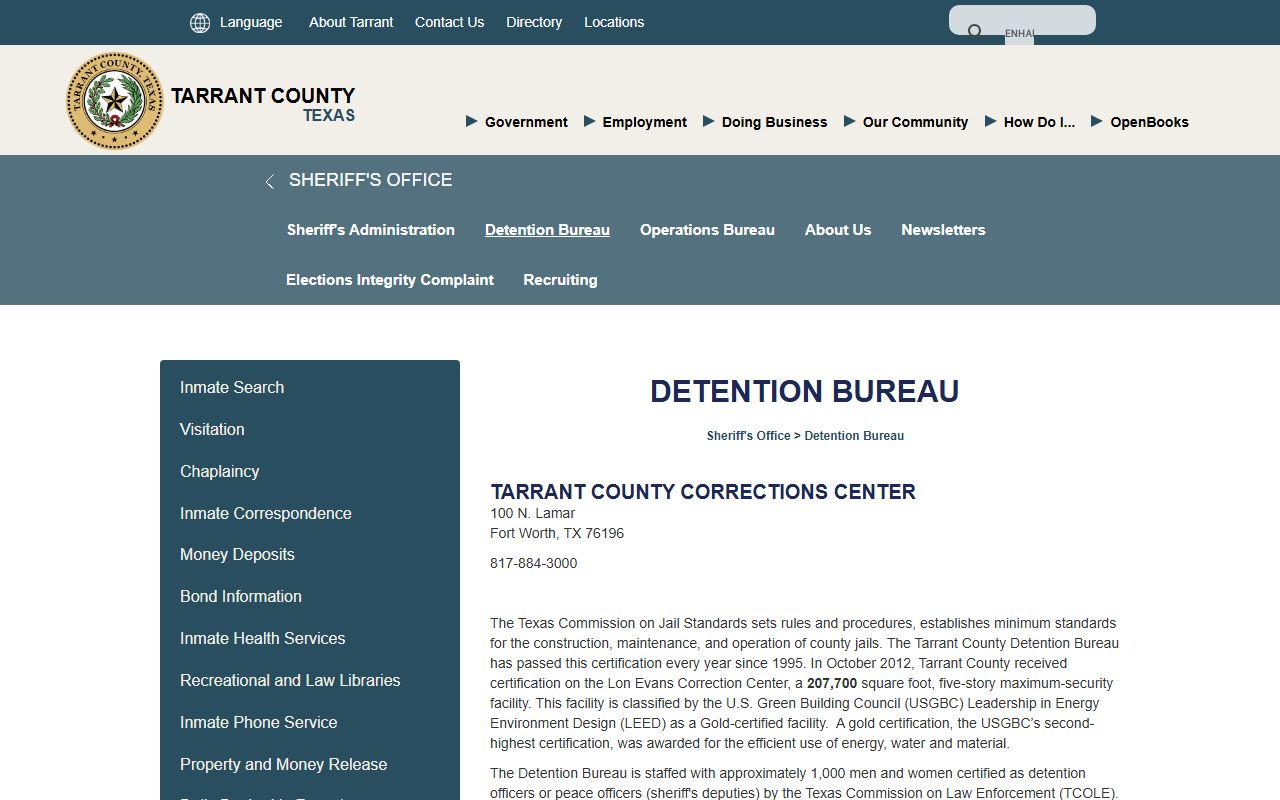
That page is the official source for facility roles, certification history, and the jail programs offered to inmates.
The Booking Process in Tarrant County
Booking is the start of custody. The arresting agency brings the person to county intake, and the Sheriff's office centrally receives them at the Corrections Center. Staff run identification, take a photo, and enroll the person by iris scan. A classification and medical screening follows, which decides housing by gender, custody level, medical or mental-health needs, and which facility has room.
The CID is created here. It is the custody ID that ties every part of the booking record together, and it is the field that gives the cleanest roster lookup later. After booking, the person sees a magistrate. The magistrate reviews the charge and sets conditions.
Bond is set at or after that appearance. It may be cash, surety, a personal bond, or no bond at all, depending on the charge and the court. The Sheriff posts a magistration docket that lists scheduled magistrate appearances, so family and bondsmen can track the next step. About 600 inmates are moved to various courts each week as cases progress.
Reading the In Custody Status
The roster does not flag a release date in the result list. Instead it answers a simpler question. The In Custody column tells you whether the person is held in the county jail at the moment you search. That is the field most families check first.
When someone is no longer held, the active custody flag changes. A person who posted bond, was released by court order, or was transferred can drop off active custody or show a different status. If a name stops appearing, that often means custody ended, but it is not proof on its own. For a recent release, search the last name broadly and check the daily reports linked from the Sheriff page. To confirm a release for legal use, call jail information at 817-884-3116 or the Detention Bureau at 817-884-3000. The released inmates page walks through verifying a release and setting up alerts.
Sending Money to a Tarrant County Inmate
Inmate money accounts pay for commissary and some services. The Sheriff installed money kiosks in facility lobbies in January 2018, and the office added several digital ways to deposit funds. There is one firm rule to remember. The Sheriff's office no longer accepts cash by mail or in person, and cash sent through the mail is returned to the sender. The methods below are the approved channels.
| Method | How | Notes |
|---|---|---|
| Online | Access Corrections website | Visa or MasterCard; lowest handling charge |
| App | Access Corrections mobile app | Android or iOS; needs an account and card |
| Phone | Access Corrections 866-345-1884 | Open 24/7 with bilingual help |
| Lobby kiosk | Kiosk in a facility lobby | Accepts cash on site |
| Cash walk-in | Cash Pay Today 844-340-2274 | Enroll first; a barcode is required at some stores |
| U.S. Postal or Western Union money order | Mail to the Detention Bureau, 100 N. Lamar, Fort Worth, TX 76196 | |
| Cash by mail or in person | Not accepted | Mailed cash is returned to the sender |
The Access Corrections app and website carry the lowest handling charge of the digital options. Cash Pay Today needs a one-time enrollment, and some retail spots want a printed barcode and ID. Check the rules for your store before you go.
The county lays out every deposit method on its inmate money deposits page, shown below.
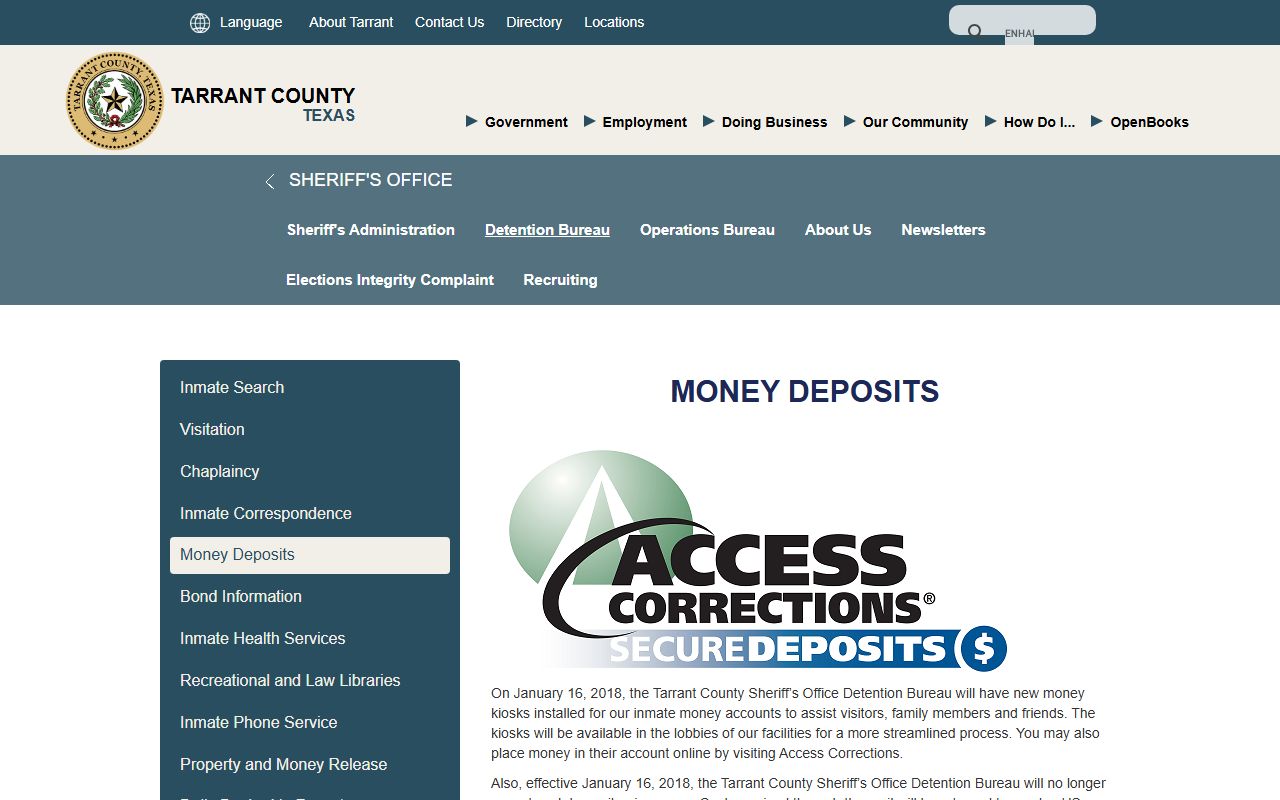
Use that official page for current vendor links and any change to the accepted payment types.
Visitation, Mail, and Contact
The Sheriff handles visitation, mail, and inmate phone service through linked pages on the official site. In general, county jail visits run on a set schedule by facility and housing, and visitors need a valid government photo ID. You confirm where the person is housed first, then book or attend a visit under that facility's rules. Weapons and contraband are never allowed, and attorney visits follow a separate attorney procedure rather than the public visit rules.
Exact visitation hours, dress code, child-visitor rules, and the video and phone vendors are not published in the source used here. Do not assume a schedule. Confirm the current visitation hours and rules on the Sheriff page before you plan a trip. The Sheriff page also links inmate correspondence and inmate phone service, which set the mail and call rules.
Start at the official Sheriff page for visitation, mail, and phone details. Calling jail information at 817-884-3116 is the fastest way to confirm a visit slot.
When the Search Points to State Prison
The county roster ends where the state system begins. If a person was convicted and sent to a Texas prison, the county jail roster will no longer hold them as active custody. State inmates are tracked by the Texas Department of Criminal Justice. That database searches by last name, first name, a TDCJ number, or a state ID number, and it serves the prison and parole context rather than county pretrial custody.
You can run a state search through the TDCJ inmate search, shown below.
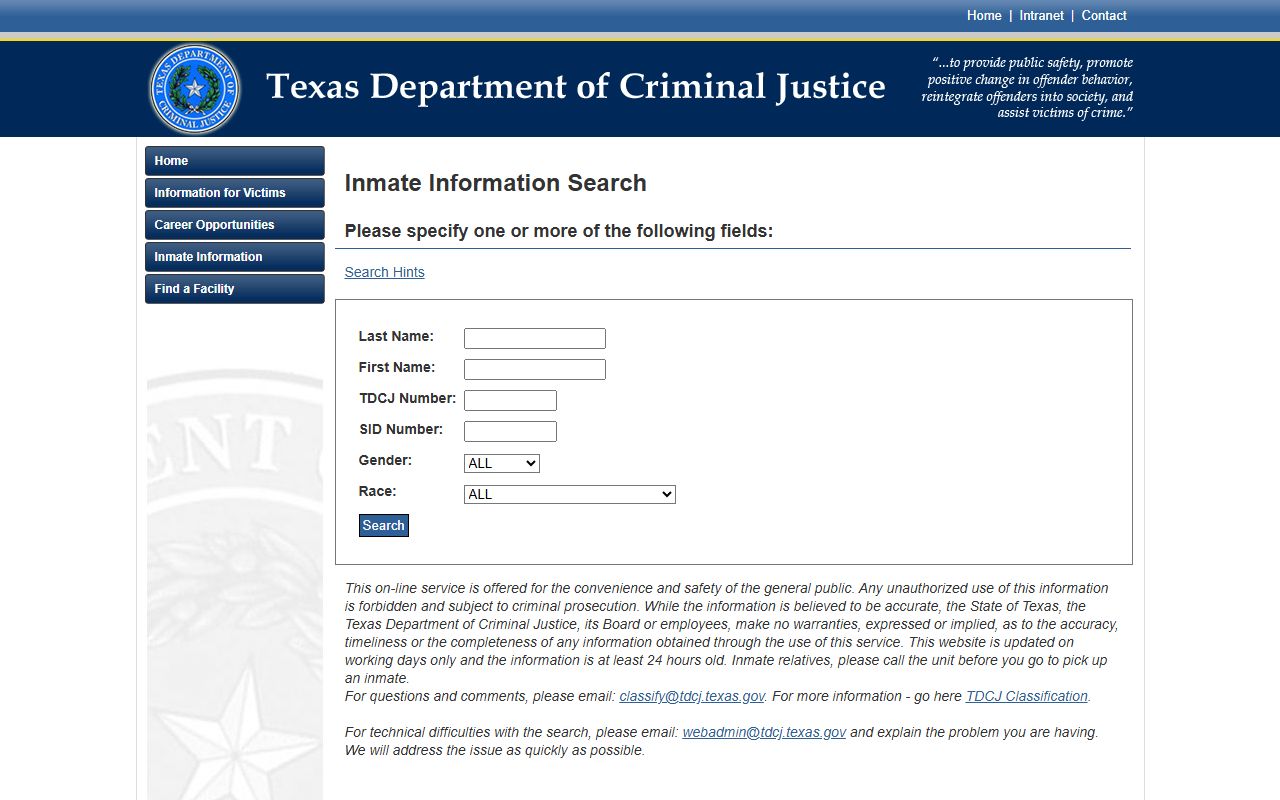
If the county roster shows no active custody and the case ended in a prison sentence, the state locator is the next stop. The warrant records page covers the limits on public warrant data, since warrant detail is not released to the general public.
Federal Custody and the BOP Locator
Federal cases follow their own track. A person held on a federal charge is not in the county jail roster as a federal inmate, and the Texas state locator will not list them either. The federal Bureau of Prisons keeps its own inmate locator. You can find a person by a BOP register number or by name, with race, age, and sex filters to narrow the result. It returns federal custody only.
The federal search runs on the BOP inmate locator, shown below.
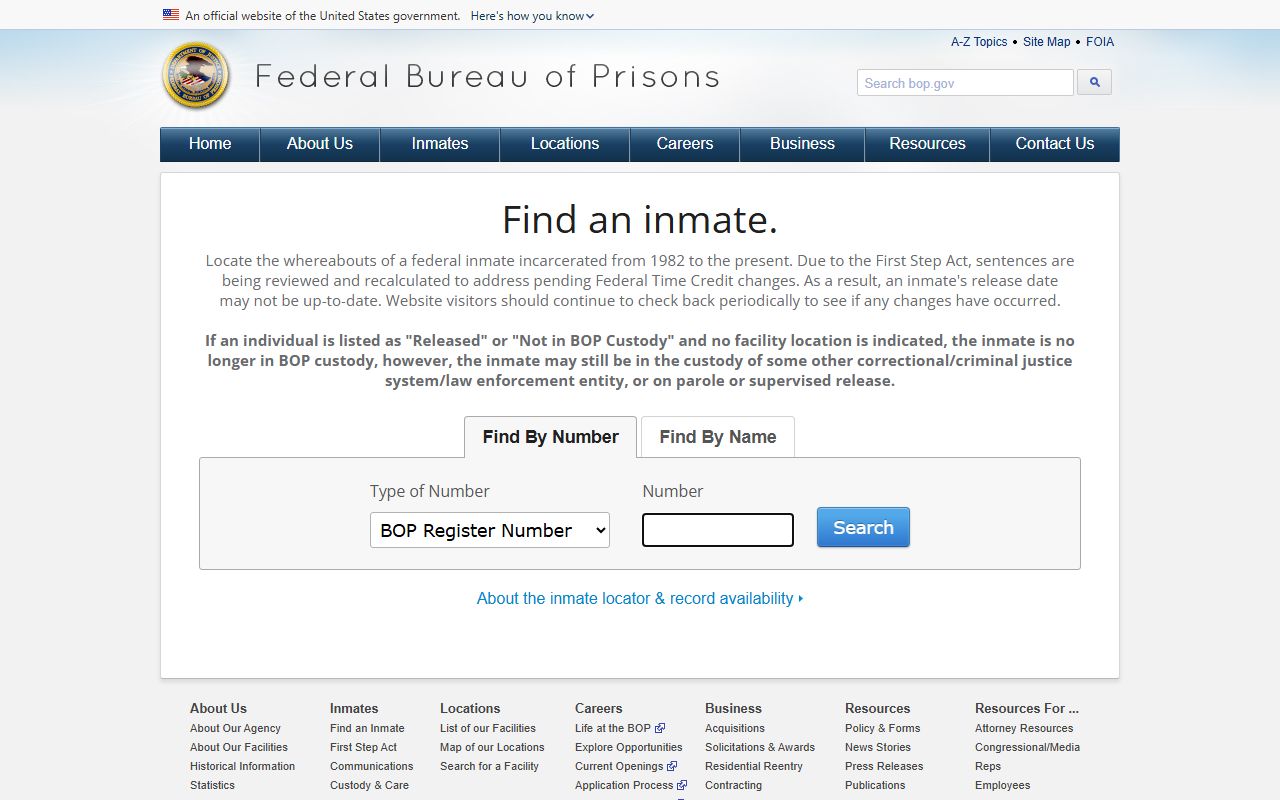
Use the BOP tool when a case is federal, and use the county roster for county jail custody. For the booking that started a county case, the arrest records page covers arrests, blotters, and how recent bookings appear.