
Texas Public Information Act in Tarrant County
Open government in Texas runs on the Texas Public Information Act, found in Government Code Chapter 552. The law sets a simple rule. The public is entitled to information about what the government does. Government Code § 552.001 states the policy: each person can get complete information about the affairs of government and the official acts of public officials, unless another law says otherwise. That policy covers the Tarrant County offices that hold records, from the County Clerk to the Sheriff.
The Act also says when records must be available. Government Code § 552.021 requires public information to be open during normal business hours. Anyone can ask. You do not have to be a resident, a party, or a lawyer. A public record is the information a county office writes, keeps, or holds in the course of its work. Emails, reports, contracts, deeds, and filings can all qualify. The law does carve out exceptions, and the courts work under a separate set of rules covered below.
Most denials are not the last word. A county office that wants to withhold records often has to ask the Texas Attorney General first.
Court Records and the Judiciary Exception
Court records are public records too, but they do not move through the standard open-records process. Government Code § 552.0035 pulls judiciary records out of ordinary Public Information Act handling. Access to information collected or kept by or for the courts is governed by rules the Supreme Court of Texas adopts, plus other applicable laws and court orders. That is a real difference. A clerk's case file is not treated the same way as a Sheriff administrative email.
What does that mean in practice? You ask the clerk or the court for a case file, not a county records officer using a generic request form. District civil, family, and felony criminal documents go through the District Clerk, Thomas A. Wilder, and the Court Document Lookup tool. County civil, probate, misdemeanor criminal, and recorded documents go through the County Clerk, Mary Louise Nicholson. To search those files, see the court records page and the District Clerk page. The County Clerk side is covered on the County Clerk page.
Two tracks, one courthouse. County administrative records flow through the open-records process under Chapter 552. Court case files flow through the clerk and the courts under Supreme Court rules. Ask the right track and you get a faster answer.
What Records the County Clerk Maintains
The County Clerk is the main keeper of non-court public records in Tarrant County. Mary Louise Nicholson holds far more than case files. The office records real property documents, files business and assumed names, issues marriage licenses, and handles vital records like birth and death certificates. It is also the clerk for the three County Courts at Law and the two Probate Courts, so probate, guardianship, and county civil files run through the same office.
These are the main types of public records the County Clerk keeps:
- Real property records - deeds, deeds of trust, liens, plats, and powers of attorney recorded in the official public records.
- Business and assumed names - DBA filings for both incorporated and unincorporated businesses.
- Marriage records - marriage licenses and informal marriage declarations.
- Vital records - birth and death certificates, plus court-ordered delayed certificates.
- Probate and guardianship - wills, estates, and guardianship files from the Probate Courts.
The County Clerk also holds Commissioners Court records and military discharge filings. Vital records sit at the Tarrant County Plaza Building, while recorded documents and civil files run out of the 1895 Historic Courthouse downtown.
Searching the County Clerk Official Records
The County Clerk runs an Official Records Search for recorded documents. It is the fastest way to look up a deed, a lien, a marriage record, or an assumed name without driving downtown. You do not need every field filled in. A party name or a document number plus a date range is enough for most searches. The portal banner notes that unofficial copies are free, and records were certified through a recent date when the system was last checked.
The search uses a small set of fields. Here is the field inventory for the Official Records Search.
| Field Label | Type | Required | Notes / Format |
|---|---|---|---|
| Department | Dropdown | No | Real Property default; also Foreclosures, Marriage, Assumed Names |
| Search Term | Text | No | Grantor/grantee name, subdivision, document type, or document number |
| Date Range | Date range | No | From and to dates, based on recorded date |
| Quick date filter | Buttons | No | Last 24 Hours through Last 1 Year |
| Search scope | Radio | No | Index Only, or Index and Full Text (OCR) |
| Reset Search | Button | No | Clears the form and starts over |
Index Only searches indexed fields. Index and Full Text reads the OCR text inside scanned documents. If you type two or more words in Index Only, the system checks each word on its own. Document type codes help narrow a search, such as D for Deed, GDN for Guardianship, PROB for Probate, and WILL for a will.
How to File a Public Records Request in Tarrant County
For county administrative records that are not court files, you file an open-records request under Chapter 552. The request goes to the office that holds the record, not to a single central desk. You can usually send it by mail, by email, or in person during business hours. Put your request in writing and be specific. A clear description gets a faster, cheaper response.
- Identify the right office. Recorded documents and vital records go to the County Clerk. Sheriff records go to the Tarrant County Sheriff's Office. Court case files go to the District Clerk or County Clerk through the court process.
- Describe the records you want. Name the document type, the dates, the people or property involved, and any case or instrument number you have.
- Submit the request in writing by mail, email, or in person. Include your name and a way to reach you.
- Wait for the response. The office must respond promptly and may ask the Attorney General before it withholds anything.
- Pay any fees, then receive the records in the format you asked for, such as paper copies or an electronic file.
Note: Court records do not use this open-records form, so ask the clerk or the court directly for case files under the judiciary rules.
Public Records Request Form Fields
A good request answers the basic questions before the office has to ask. List what you want, the dates, and how you want to get it. The fields below mirror what a county open-records request needs.
| Field | Required | Notes |
|---|---|---|
| Requester Name | Yes | Your full name and a way to reach you by phone, email, or mail |
| Description of Records | Yes | Be specific: document type, parties, property, or case number |
| Date Range | No | Narrows the search and can lower labor charges |
| Format Preference | No | Paper copy, certified copy, or electronic file |
| Delivery Method | No | Pick up in person, mail, or email |
The County Clerk also posts fillable forms for common needs. Those include an Assumed Name Application, a birth or death record application in English and Spanish, a Marriage Information Form, and a Military Discharge Request. The forms page notes the files have editable fields, and your browser may need to download a form before it opens right.
Response Timelines
Under the Public Information Act, a county office must respond promptly to a written request. If a record is clearly public, the office produces it. If the office thinks a record is confidential or exempt, it usually has to ask the Texas Attorney General for a ruling before it can withhold the record. That step adds time but protects the requester's right to a written answer.
Some requests take longer than others. A large date range or a vague description can slow things down and raise labor costs. A tight, specific request moves faster. If your request is denied or stalls, you have options, which are covered further down this page.
Tarrant County Public Records Fees
Looking at a record in person at the clerk's office is free. Copies, certified copies, and recording carry set charges. The County Clerk posts recording and copy fees, and the Attorney General sets the cost rules for open-records labor and copying. The table below lists common County Clerk charges. Confirm current amounts with the office before you pay, since checkout fees can differ from posted copy rates.
| Item | Amount |
|---|---|
| Real property recording, first page | $20 |
| Each additional recorded page | $4 |
| State lien filing | $12 |
| Federal lien filing | $25 |
| UCC standard, no attachment, one debtor | $30 |
| Plat, 24 x 36 | $65 |
| Marriage license | $76 |
| Marriage license with premarital course certificate | $16 |
| Will for safekeeping | $5 |
Some fees drop when you take a step ahead of time. A couple who finishes a Texas premarital course pays a reduced marriage license fee. Out-of-state applicants who cannot prove Texas residency pay an added fee. For full marriage details, see the marriage and divorce records page.
Sheriff Public Records
The Tarrant County Sheriff's Office holds its own set of public records. Sheriff Bill E. Waybourn oversees the office and the jail system. Administrative records like incident reports, jail rosters, and department documents are processed as public information under Chapter 552, not under the court rules. You request them from the Sheriff's Office, the same way you would ask any county department.
Not everything the Sheriff holds is open. Government Code § 552.108 lets law enforcement withhold active investigation and prosecution information when release would interfere with an open case. Basic facts about an arrest can still be public even when the full file is not. For booking data and the jail roster, see the criminal records page.
Redactions and Personal Data
Even open records get cleaned up before release. Texas law tells county offices to hide certain personal data inside otherwise public files. The clerk and the courts redact these items so the rest of the record can stay public. You will see blacked-out lines or masked numbers on many copies.
A few statutes do most of this work:
- Government Code § 552.117 protects certain home addresses, phone numbers, and family details for covered people.
- Government Code § 552.147 shields Social Security numbers in public records.
- Government Code § 552.130 keeps driver license and motor vehicle information confidential in many cases.
- Government Code § 552.101 keeps information confidential when another law makes it so.
These rules are why a deed or a court filing may show a name and a date but mask a Social Security number or a license number. The redaction does not make the whole record secret. It just removes the protected pieces.
Records That Are Confidential
Some records are closed no matter which office holds them. State law makes whole categories confidential, and a public office cannot hand them out just because they sit in a county building. The biggest closed categories involve children, sealed criminal history, and medical privacy.
Juvenile records are a clear example. Texas keeps most juvenile justice records confidential, with tight limits on who can see them.
Texas Family Code Chapter 58 controls confidentiality and sealing of juvenile law enforcement, probation, prosecutor, and court records, as the official statute text on the Texas Statutes site lays out.
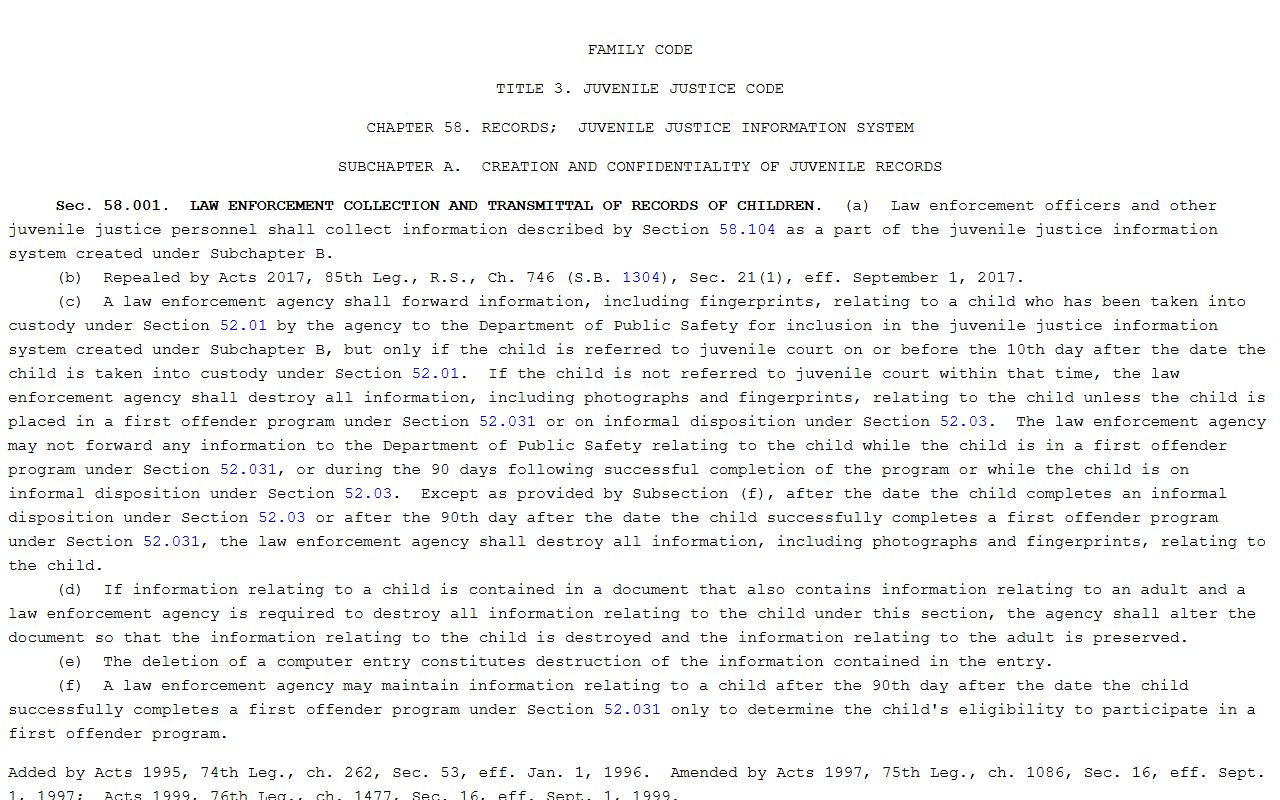
That chapter is why a juvenile case can exist in the courthouse yet stay off the public search portals.
Other confidential categories include adoption records, mental-health and guardianship details, grand jury work, and child protective services files. Each one is locked by a specific statute, and Government Code § 552.101 ties the open-records law to those confidentiality rules. To view a sealed file, you usually need to be a party, an attorney of record, or a person the court allows by order.
Expunged and Sealed Records
Expunction removes a record from public use altogether. It goes further than a nondisclosure order. After an expunction, agencies named in the order must return, delete, or destroy the records. A nondisclosure only hides a record from the public while police and certain agencies keep access. The two are not the same, and only some cases qualify for either.
The Code of Criminal Procedure Chapter 55A sets the eligibility and steps for expunction, and the official Chapter 55A statute text spells out who can ask and how the process runs.
In Tarrant County, expunction petitions are filed in district court and run through the District Clerk, who must comply with a final order.
Expunction is not automatic for most adults. A person has to fit a category in Chapter 55A, such as an acquittal, a pardon for innocence, or certain dismissed matters after a waiting period. The petitioner names every agency that holds records and asks the court for an order. If the court grants it, the records are destroyed or returned as the order says.
If Your Public Records Request Is Denied
A denial is not always final. When a Tarrant County office wants to withhold records, it often must request a ruling from the Texas Attorney General within a set time. The Attorney General then decides whether the records can be kept back or must be released. That review gives you a check on a wrongful denial without going to court right away.
If the office still refuses after a ruling, or misses its deadlines, you can take further steps. The Attorney General handles open-government complaints, and a requester can pursue a civil action to force release in some cases. Keep copies of your written request and any responses. A clear paper trail helps if you need to appeal. For related court filings, the court records page explains how to look up civil case documents.