
What Probate Covers in Tarrant County
Probate is the court process that settles what a person leaves behind and protects people who cannot manage their own affairs. In Tarrant County the reach is broad. The two Probate Courts handle probated estates, incapacitated persons and guardianships, mental-health cases, wills, court-ordered delayed birth and death certificates, and funds held on behalf of minors. So the same court that admits a will can also name a guardian or hold money for a child. That mix is normal for a Texas statutory probate court.
The County Clerk processes and maintains all of these matters. That is the office you deal with for filing, copies, and most searches. The judges sit in the Probate Courts, but the paper trail and the public index live with the County Clerk. Mary Louise Nicholson runs that office. When a record exists, it sits in the County Clerk system under a probate or will code, not with the District Clerk.
One point trips people up. Not every death needs probate. Small estates, joint property, and accounts with named beneficiaries can sometimes pass without a full case. When probate is needed, the type matters, and the type sets the forms and the fee.
The official County Clerk probate courts page lays out what the courts handle.
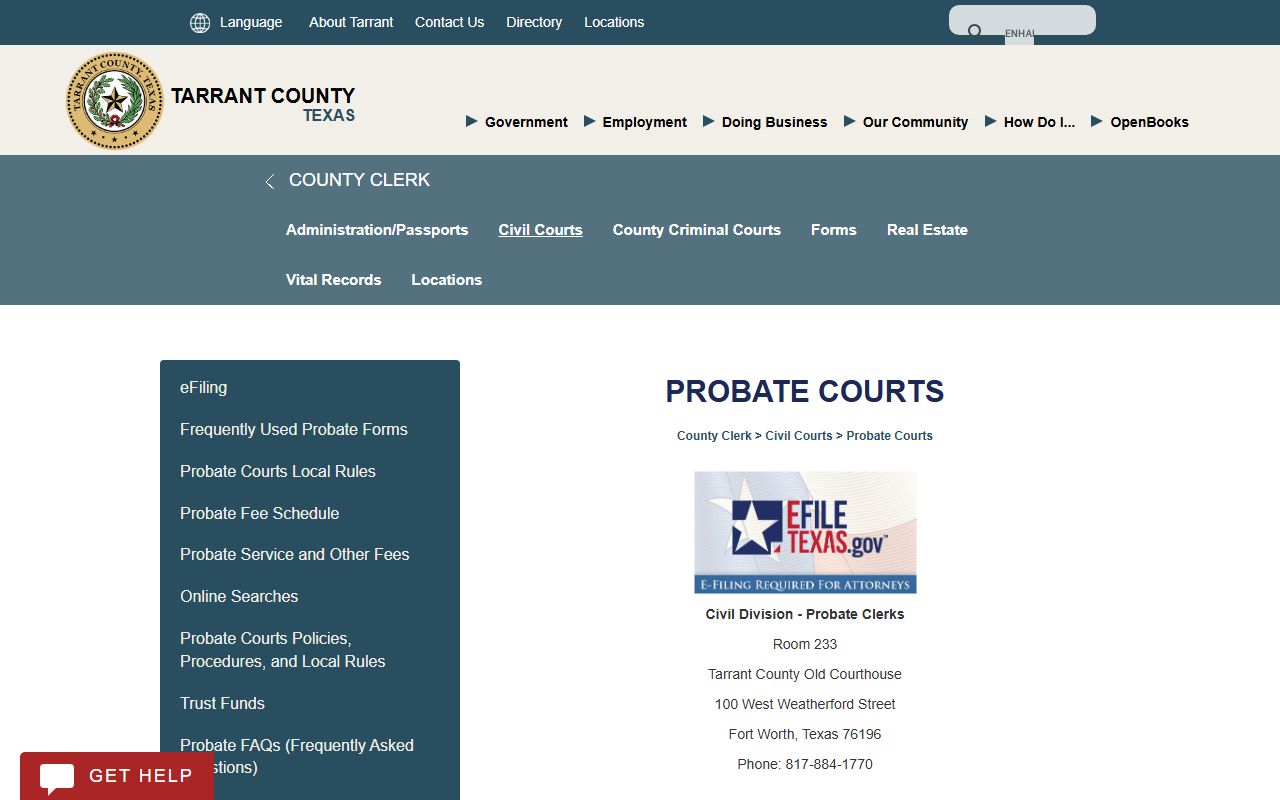
The page is the cleanest starting point to confirm whether your matter is an estate, a guardianship, or a mental-health case before you file.
Probate Terms Defined
Probate files use words that rarely come up anywhere else. A few quick definitions make the records easier to read. These terms show up in applications, orders, and the index entries you find online. Get them straight and a case file reads much faster.
- Testator
- The person who made the will. The will speaks for the testator after death.
- Executor
- The person named in a will to carry it out, gather assets, pay debts, and pass property to heirs.
- Intestate
- Dying without a valid will. State law then sets who inherits, and the court may appoint an administrator.
- Guardianship
- A court setup where a guardian is named to care for a minor or an incapacitated adult, the ward, or to manage that person's estate.
- Conservatorship
- A court-appointed role to manage another person's affairs. In Texas estate matters this work is most often handled through guardianship of the person or of the estate.
Two more come up a lot. An heirship case names the legal heirs when there is no will. A muniment of title admits a will just to clear title to property, with no full administration.
How to Search Tarrant County Probate Records
Probate records start with the County Clerk. The County Clerk Official Records Search lets you look up indexed documents by name, date, or document type. Probate index entries carry codes such as PROB for a probate matter and WILL for a will. Recorded estate documents show up there. But a full probate case file, with the application, orders, and accountings, may need County Clerk probate or civil access rather than the public recorded-document index.
Run the search the same way you would any County Clerk lookup. Have a name and a rough date range ready. A document number is even better if you have one.
- Open the County Clerk Official Records Search and enter a party name or document number in the Search Term box.
- Set a date range, or pick a quick button such as Last 1 Year, to narrow the results.
- Filter by document type if you can, looking for PROB or WILL codes to focus on probate items.
- Open a result, check the names and dates, and note the case or document number you need.
- For a full court case file, contact County Clerk probate to confirm access, then order a certified copy if a court needs one.
The County Clerk also posts probate appointment and fee reports by month and year for 2021 through 2025. Those reports help if you are tracking when a court named an executor or guardian. The recorded index is free to view as unofficial copies. Certified copies carry a fee, covered below.
Probate Courts and Filing Offices in Tarrant County
Two Probate Courts hear these cases, and the County Clerk runs the filing windows. Where you take a document depends on what it is. A will tied to an open probate case goes to the probate office. A will you only want stored for safekeeping goes to the intake office. An Affidavit of Heirship does not go to the Probate Courts at all. It is recorded in the Official Public Records office. The three cards below show each window in the 1895 Historic Courthouse at 100 W. Weatherford St.
Probate Office (Wills in Active Cases)
Room 233, 100 W. Weatherford St.
Fort Worth, TX 76196
County Clerk: Mary Louise Nicholson
Provide your assigned case number when filing the will.
Intake Office (Will Safekeeping)
Room B90, 100 W. Weatherford St.
Fort Worth, TX 76196
For storing a will only, with no open case.
Safekeeping fee: $5
Official Public Records (Heirship)
Room B20, 100 W. Weatherford St.
Fort Worth, TX 76196
File an Affidavit of Heirship here, not with the Probate Courts.
Match the document to the room first. A safekeeping will dropped at the probate window, or an heirship affidavit taken upstairs, just bounces you back to the right counter.
How Probate Works in Tarrant County
A probate case moves through clear stages. The first step is figuring out which kind of case you have, since that drives every form after it. Texas offers several paths. Will probate, independent administration, dependent administration, a small estate affidavit, an heirship proceeding, a guardianship, a mental-health proceeding, or a muniment of title each follow their own track. Pick wrong and the clerk sends the papers back.
Once you know the type, the steps run in order. The walkthrough below follows the County Clerk and Probate Court process.
- Determine the probate type, such as will probate, administration, small estate affidavit, heirship, guardianship, or muniment of title.
- File the application and the required information sheet and forms with the County Clerk or probate office.
- Pay the filing fee, or file a Statement of Inability to Afford Payment to ask for a waiver.
- The court issues a citation or notice, and service may go by process server, sheriff or constable, publication, or another method.
- Attend the probate hearing and prove death, jurisdiction, the will's validity, the heirs, and the need for administration.
- If granted, the court signs an order and the clerk issues letters testamentary, of administration, or of guardianship.
- File the oath, a bond if required, and the inventory, appraisement, and list of claims, or an affidavit in lieu when allowed.
- Give creditor notices, manage the estate, file accountings or annual reports if required, distribute the property, and close the case.
Most uncontested estates with a clear will move faster than guardianships, which carry extra oversight. A contested case can stretch for months. The County Clerk records each step, so the public index shows the path the case took.
Tarrant County Probate Forms
The County Clerk posts a set of probate forms you can fill out before you file. Using the right form for your case type keeps things moving. Most filers need a case information sheet plus the form that fits their matter. Fee-waiver and redaction forms are there too. The county lists each one on its forms page.
These are the main forms the County Clerk provides for probate filers.
- Small Estate Affidavit with Instructions - covers decedent identity, date and place of death, assets and debts, heirs, and sworn signatures.
- Statewide Information Sheet and its instructions - case type, party names, addresses, and attorney details.
- Supplemental Probate Case Information Sheet - decedent, ward, or proposed guardian details and the estate type.
- Statement of Inability to Afford Payment - income, benefits, dependents, and expenses for a fee waiver.
- Application for Private Professional Guardian - guardian identity, certification, and disclosures.
Other forms round out the set. There is a Criminal Background Authorization Form for proposed guardians, a Request for Redaction of Social Security Number, a Request for Abstract of Judgment, and a Depositing Money in the Registry form. The county's frequently used probate forms page hosts the current versions.
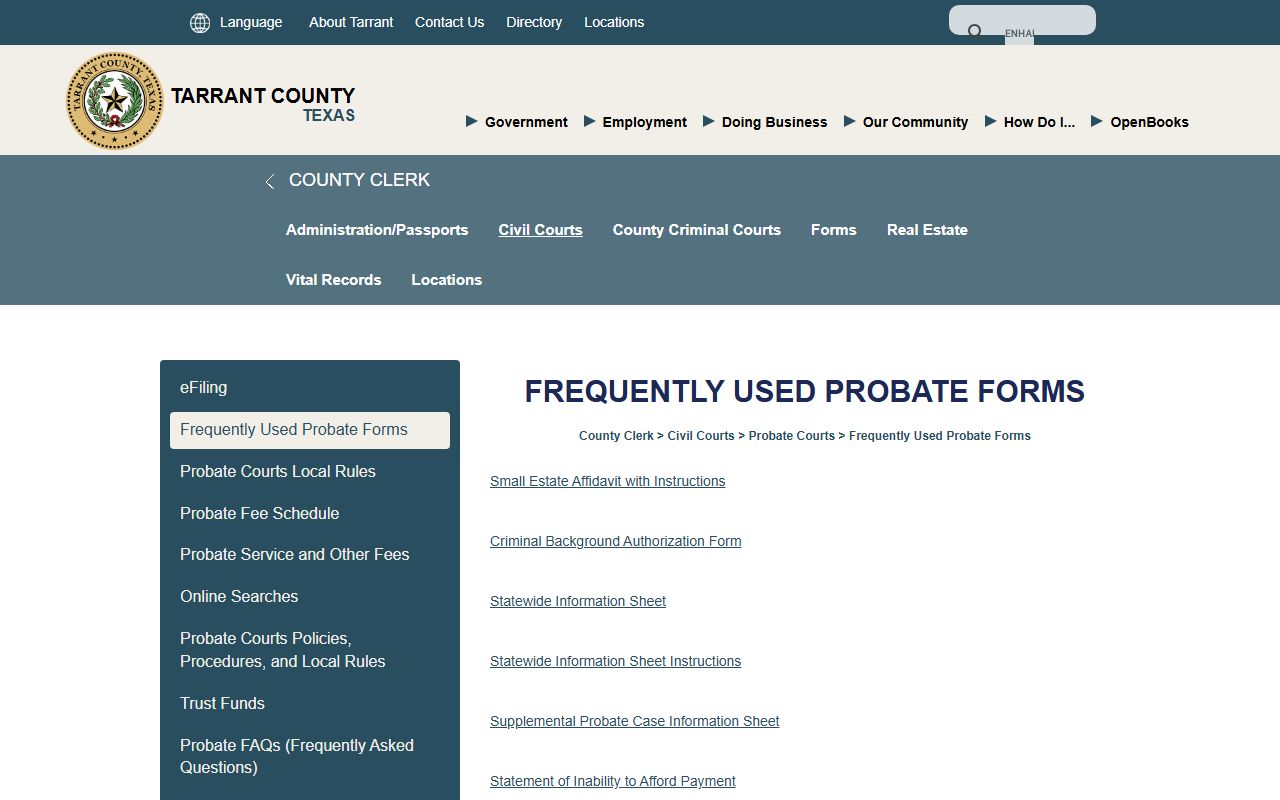
Pull the form that matches your case type before you head downtown, since the clerk will not draft it for you.
Probate Filing Fees in Tarrant County
Fees depend on what you file. Storing a will costs little. Starting a small estate case costs more. Viewing the recorded index online is free as an unofficial copy, while certified copies carry a charge. The County Clerk sets the probate fee schedule, and the current schedule is effective January 1, 2026. Check it before you pay, since court costs change.
| Item | Amount |
|---|---|
| Will safekeeping (storage only) | $5 |
| New Small Estate Affidavit filing | $404 |
| Unofficial copy from online index | Free |
The full probate fee schedule lists costs for applications, citations, and other filings beyond these. The official probate fee schedule page carries the current figures.
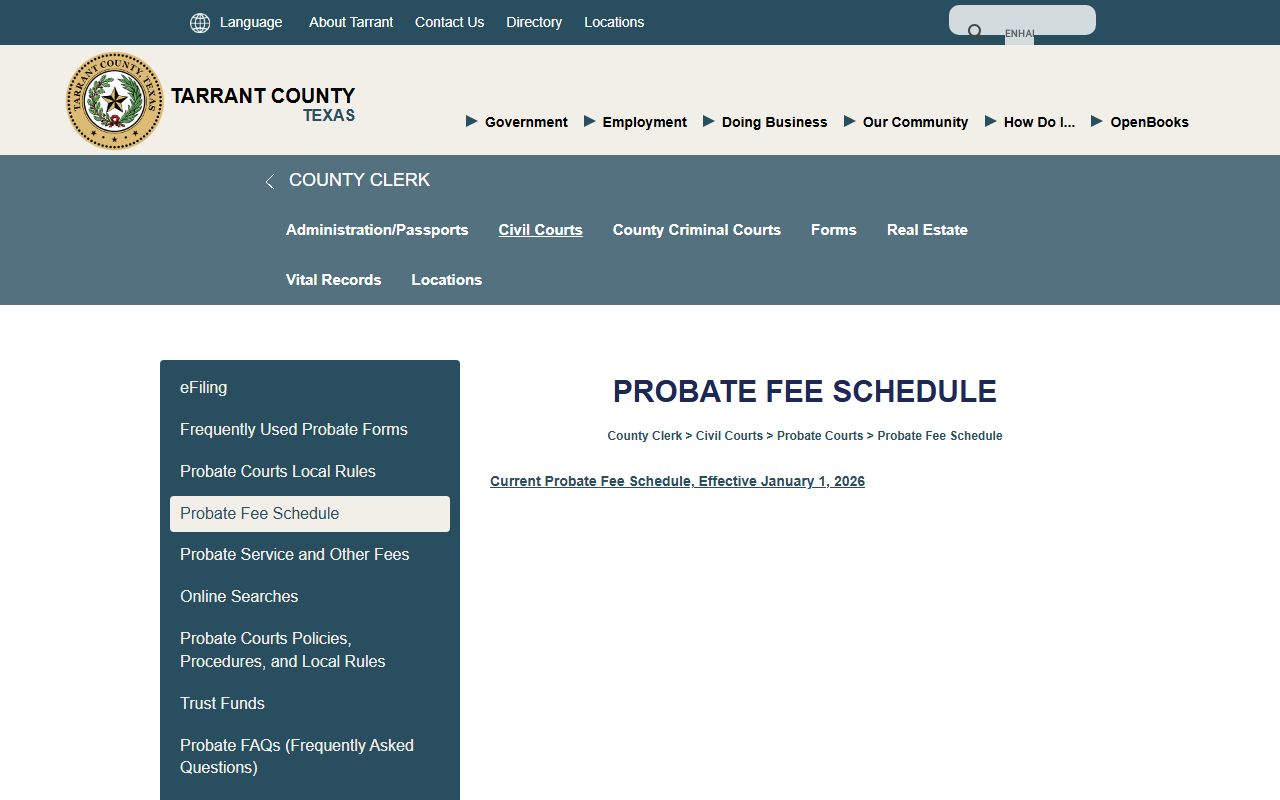
Confirm the line item that fits your case, because a small estate filing and a simple will deposit sit at very different price points.
Note: If you cannot pay, file a Statement of Inability to Afford Payment with the County Clerk to ask the court to waive the filing fee.
What Tarrant County Probate Records Show
A probate file is more than a will. It holds the whole life of the case. Open one and you find the application that started it, the order that admitted the will, and the letters that name the executor or guardian. After that come the inventory and appraisement, the list of claims, creditor notices, and any accountings the court required. The final entries show distribution and the order that closed the case.
Guardianship files read a bit differently. They carry the application, the order naming the guardian, and the annual reports that track the ward and the estate. Mental-health cases include commitment and medical material, which is why they are handled with more privacy than a plain estate.
The County Clerk index lists each recorded item by document code. A WILL entry points to a deposited or admitted will. A PROB entry points to a probate matter. The recorded image lets you read the document, while the case file shows the order events behind it.
Many filers reach probate from a related record. A death starts an estate. A divorce or a marriage can change who inherits. For those records see marriage and divorce records.
Restricted Probate Records
Not every probate file is fully open. Texas law protects parts of these cases, even when the court holds them. Guardianship and mental-health details may be restricted. Commitment and medical information in a mental-health proceeding carries privacy protection under state health and safety law and court orders. So the index may show that a case exists while the sensitive content stays closed to the general public.
Personal identifiers get shielded too. The County Clerk offers a Request for Redaction of Social Security Number form so a filer can keep that number out of the public record. Funds held for minors are court-controlled, and those custodial accounts are managed by court order rather than open to anyone who asks.
To see a restricted record, you usually need to be a party, an attorney of record, or someone the court allows by order. The County Clerk and the Probate Courts apply these limits the same way other Tarrant County courts handle confidential files. For the broader rules on sealed and confidential material, see court records.
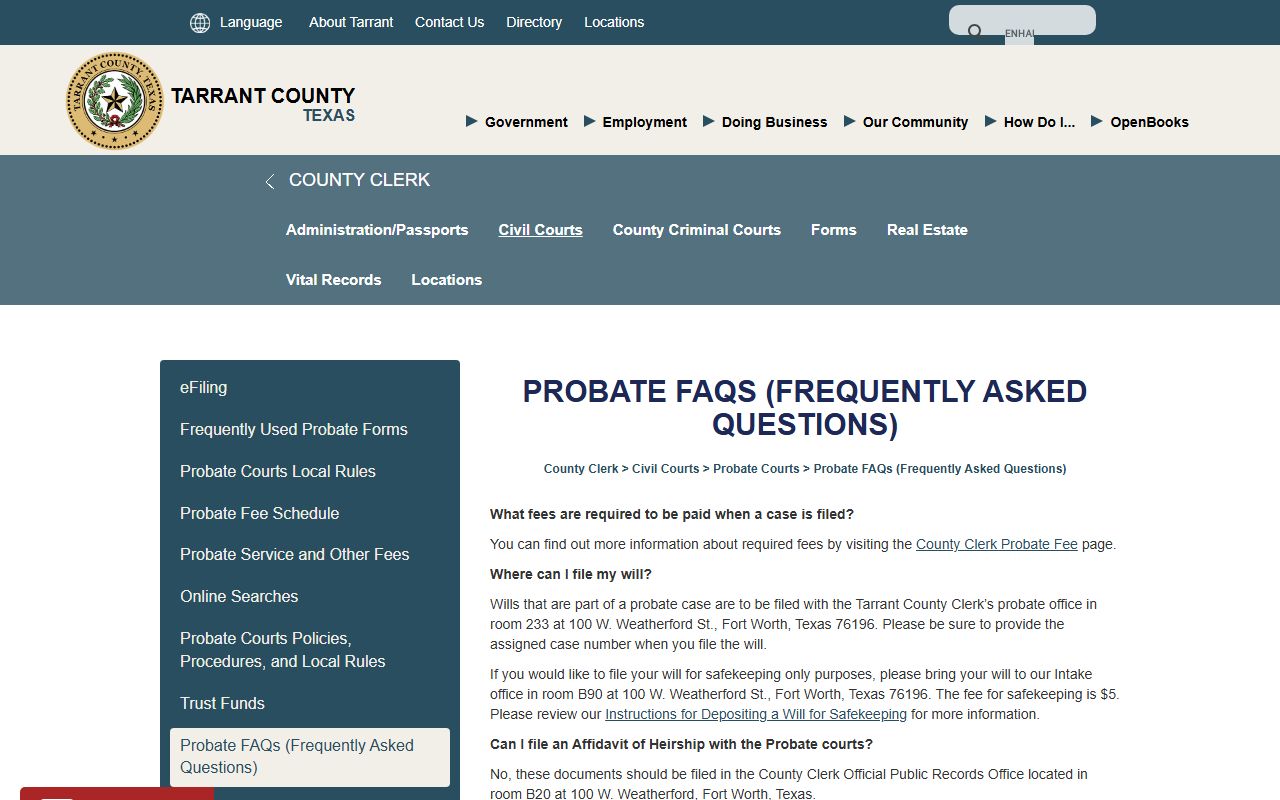
The County Clerk probate FAQ page answers common questions about access, filing, and what stays private.