
How to Search Tarrant County Court Records
There is no single search box for every Tarrant County court. You pick the portal that holds your record. District civil, family, and felony criminal case documents go through the Tarrant County District Clerk and the Court Document Lookup service. County civil cases, probate, county criminal, marriage, real property, and assumed names go through the County Clerk Official Records Search. Justice of the Peace and city municipal cases live with the court that filed them.
Before you start, gather what you have. A cause number is best. A full name plus a date range works too. Know the court if you can, and the document type you want. The county courts landing page links every court type and is a good first stop.
- Pick the portal that matches the case. Use the County Clerk Official Records Search for recorded and county records, or the District Clerk public search for district court documents.
- Enter a party name or a document number in the Search Term box.
- Set a date range, or use a quick date button such as Last 1 Year.
- Choose Search Index Only for indexed fields, or Search Index and Full Text for OCR text inside documents.
- Open the result, confirm the names and dates, and order a certified copy if you need one for court.
The county publishes its court list and court navigation on the official Tarrant County courts page, which sorts links by civil, criminal, family, juvenile, probate, and justice courts.
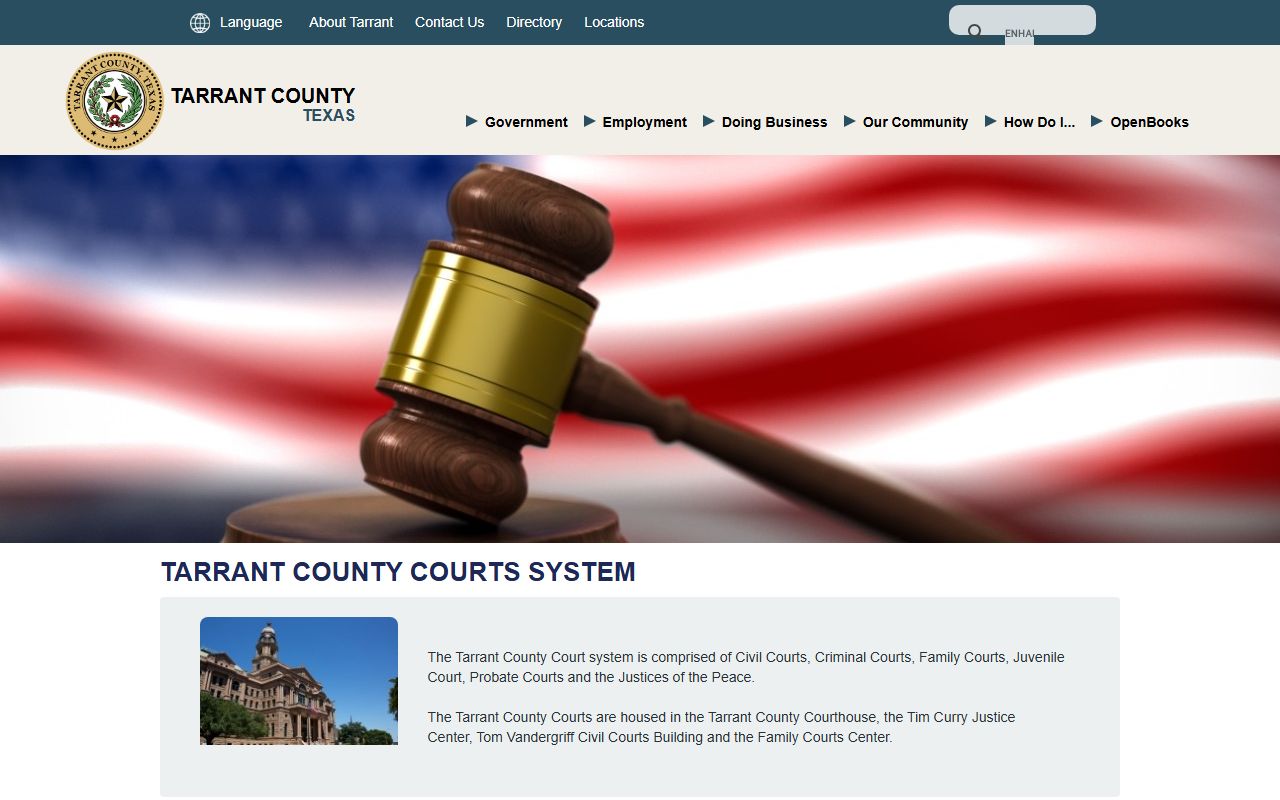
The landing page is the cleanest way to confirm which court hears your matter before you choose a search portal.
Tarrant County Court Records Search Fields
The County Clerk Official Records Search uses a small set of fields. You do not need every field filled. A name or a document number plus a date range is enough for most searches. The portal showed records certified through 05/21/2026 on the date it was checked.
| Field Label | Type | Required | Notes / Format |
|---|---|---|---|
| Department | Dropdown | No | Real Property, Foreclosures, Marriage, Assumed Names |
| Search Term | Text | No | Party name, subdivision, document type, or document number |
| Date Range | Date range | No | From and to dates, based on recorded date |
| Quick date filter | Buttons | No | Last 24 Hours through Last 1 Year |
| Search scope | Radio | No | Index Only, or Index and Full Text (OCR) |
The District Clerk public search uses the same field layout, but its default department is Warrants and it points at district court documents.
The Tarrant County Judicial System
Texas stacks its courts by case size and seriousness. District courts are the trial courts of general jurisdiction. In Tarrant County many of them specialize, so you find civil, felony criminal, family, and juvenile district courts in separate buildings. County Courts at Law sit a step below for mid-size civil cases and misdemeanors. Justice of the Peace courts handle the smallest civil claims and many citations. Above them all sit the appeals courts.
A case can move up. Most Tarrant County trial-court appeals go to the Second Court of Appeals in Fort Worth. Civil and juvenile matters can then reach the Supreme Court of Texas. Criminal matters go to the Texas Court of Criminal Appeals.
Case flow: Justice Court › County Court at Law › District Court › Court of Appeals › Texas Supreme Court or Court of Criminal Appeals
| Court | Civil Limit | Main Case Types | Recordkeeper |
|---|---|---|---|
| District Court | No fixed ceiling | Felony criminal, major civil, family, juvenile | District Clerk |
| County Court at Law | Up to $250,000 | Mid-size civil, misdemeanor, probate | County Clerk |
| Justice of the Peace | Up to $20,000 | Small claims, evictions, Class C citations | JP court |
The Texas Judicial Branch explains this structure on its About Texas Courts page.
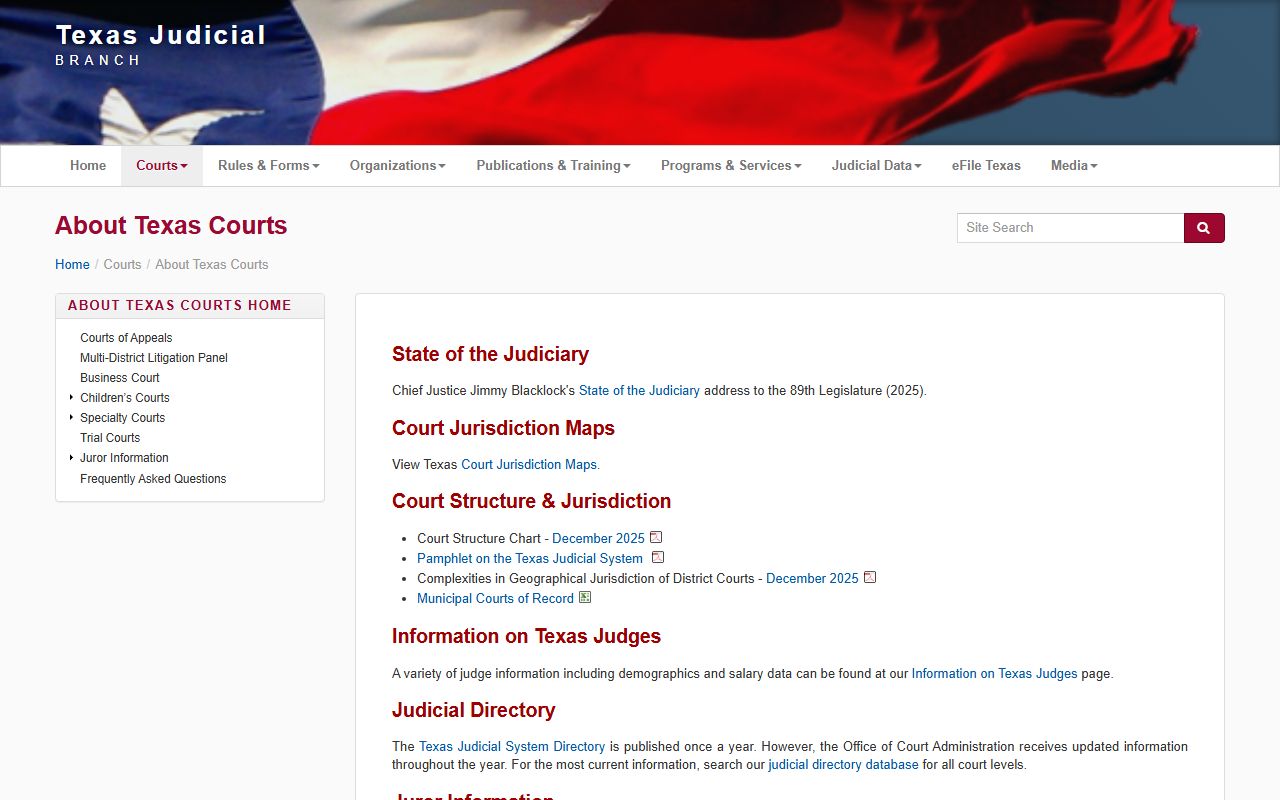
The state chart shows why a Tarrant County felony and a Tarrant County small-claims case end up in different clerks' files.
Tarrant County has 28 elected courts plus 22 associate judges and magistrates. The district courts list shows criminal courts at the Tim Curry Justice Center, civil courts at the Tom Vandergriff building, family courts at the Family Law Center, and a juvenile court at the Scott D. Moore center.
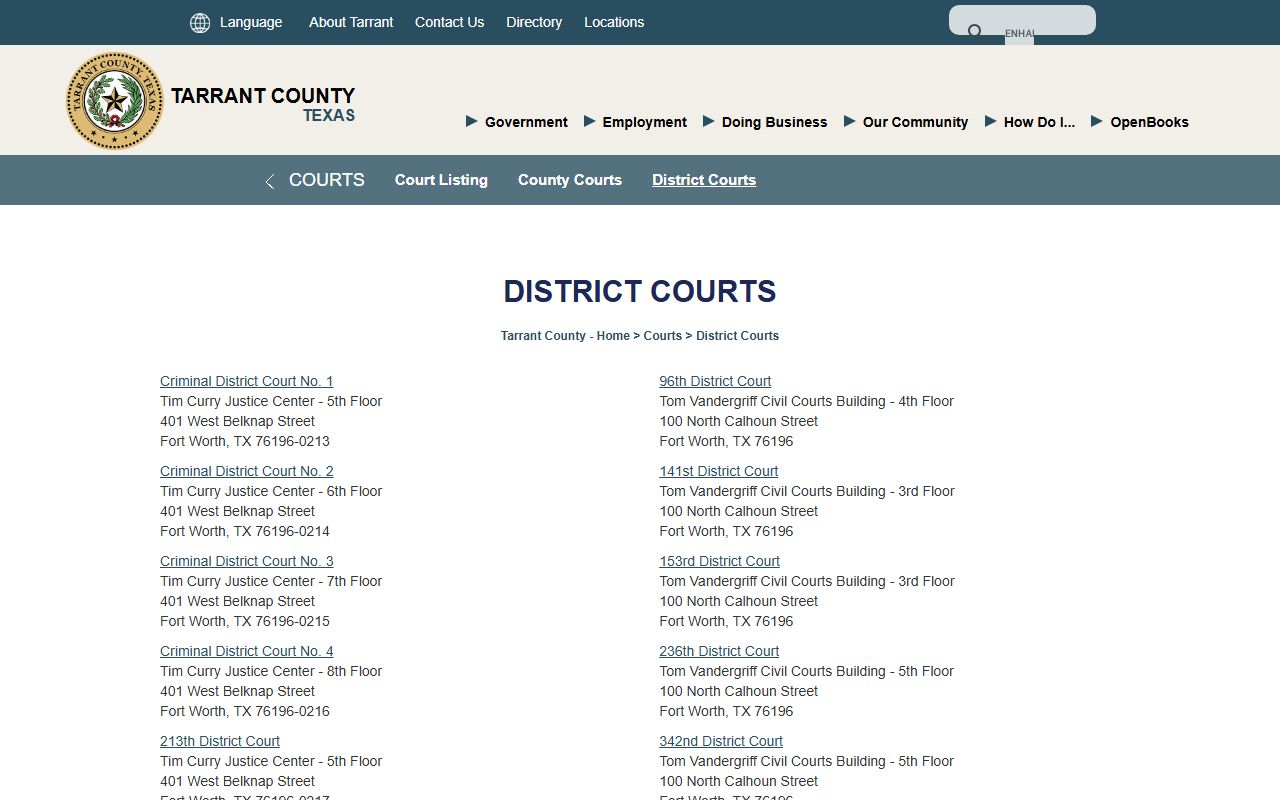
Knowing the building tells you the floor and phone before you ever drive downtown. More detail sits on the Tarrant County District Court page.
Tarrant County Courthouses
The court campus is a tight downtown cluster, but the buildings are not interchangeable. The 1895 Historic Courthouse holds County Clerk public records and civil courts. Tom Vandergriff Civil Courts handles district civil cases. Tim Curry Criminal Justice Center handles felony and county criminal work. The Family Law Center handles family district courts. Vital records sit at the Tarrant County Plaza Building. Match the building to the case before you park.
1895 Historic Courthouse
100 W. Weatherford St.
Fort Worth, TX 76196
817-884-1195
Tim Curry Criminal Justice Center
401 W. Belknap St.
Fort Worth, TX 76196
817-884-1574
Tom Vandergriff Civil Courts
100 N. Calhoun St.
Fort Worth, TX 76196
817-884-1574
The county home page links each office, fee schedule, and department in one place.
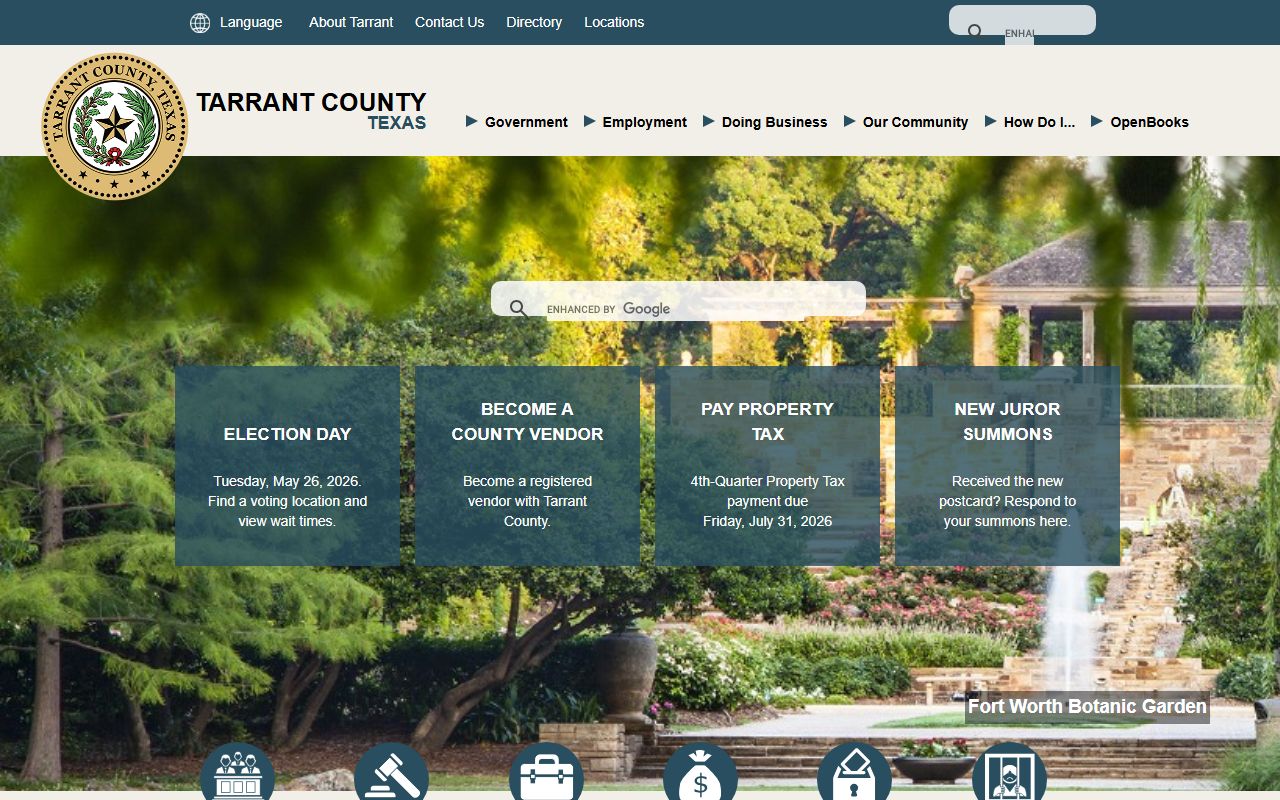
Use it to confirm an address and hours before a trip, since several buildings share the 76196 ZIP but sit blocks apart.
Types of Court Records Available in Tarrant County
Tarrant County court records cover most kinds of cases. The clerk that holds the file depends on the court. District-level files go to the District Clerk. County-level files go to the County Clerk. Justice and municipal courts keep their own records.
These are the main record types you can find and where each one lives.
- Civil district records - large lawsuits, tax suits, and injunctions, held by the District Clerk.
- Felony criminal records - indictments, judgments, and sentences from the criminal district courts.
- Family and divorce records - divorce, custody, and support files from the Family Law Center.
- County civil and probate records - mid-size civil cases and estates, held by the County Clerk.
- Traffic and citation records - filed in Justice of the Peace or city municipal courts.
County Courts at Law take civil cases up to $250,000 plus probate matters. The county lists each one with its judge and phone.
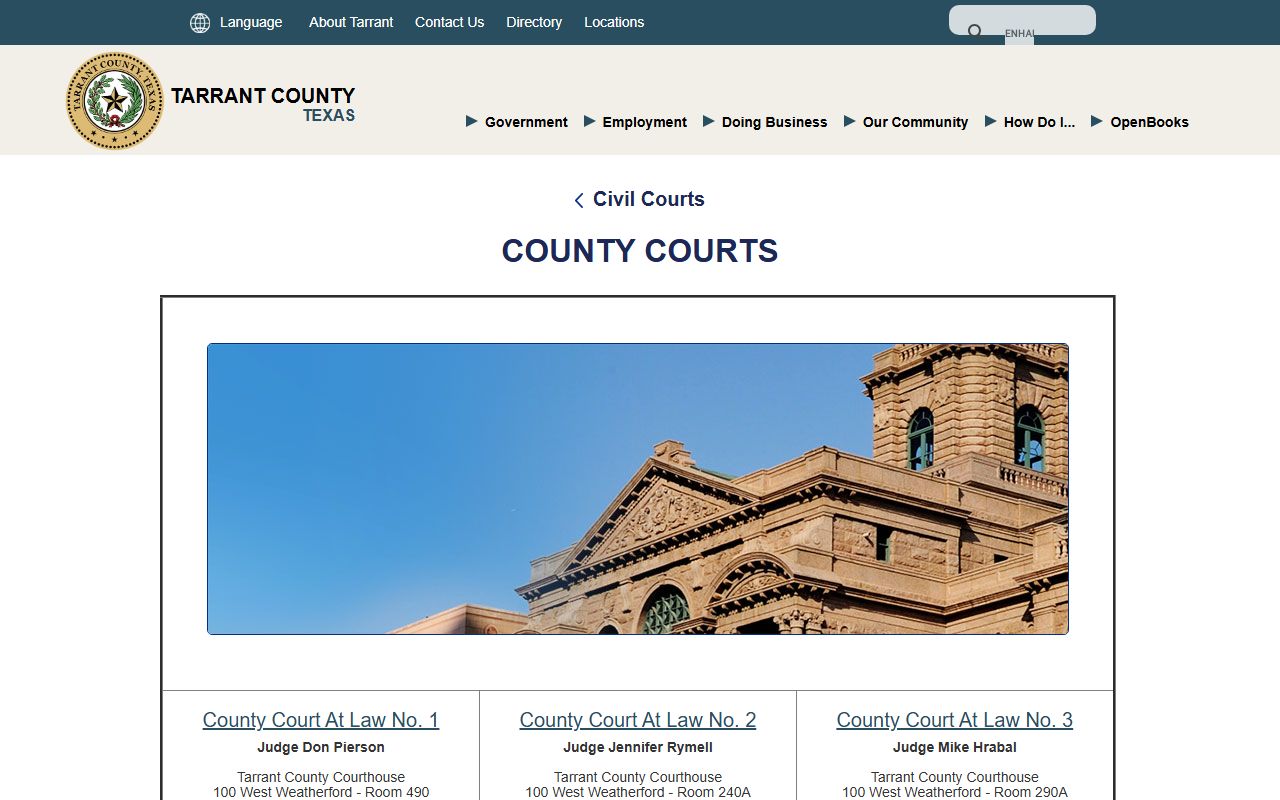
For the smallest cases, the eight Justice of the Peace courts handle evictions, small claims, and many traffic citations.

If a state or county agency wrote your ticket, a JP court likely holds it; a city police ticket usually goes to that city's municipal court.
What Tarrant County Court Records Show
A court record is more than a name and a charge. Each file carries identifiers, parties, dates, and the path the case took. Public portals redact sensitive items like Social Security numbers, driver license numbers, and minor identifiers. Here is what a typical record shows.
| Field | What It Shows |
|---|---|
| Cause Number | The court's unique case identifier |
| Court | The court and number, such as 17th District Court |
| Filing Date | When the case or document was filed or recorded |
| Parties | Plaintiff and defendant, or petitioner and respondent |
| Charges / Cause | The charge in a criminal case or the claim in a civil one |
| Disposition | The outcome, such as dismissed, convicted, or granted |
The District Clerk Court Document Lookup pulls these fields from civil, family, and felony criminal cases. The County Clerk portal uses document type codes such as D for Deed, J for Judgment, PROB for Probate, and WILL for a will.
Public Access Laws for Tarrant County Court Records
Most Texas government records are open under the Texas Public Information Act. Court records work a little differently. The judiciary follows rules set by the Supreme Court of Texas, not the standard agency request process. So you ask the clerk or court for a case file, while you ask a county department for things like sheriff administrative records.
A few statutes do most of the work here. Some open records up. Others lock specific records down.
Key Statutes:
Texas Government Code § 552.001 - sets the policy that the public is entitled to information about government affairs.
Texas Government Code § 552.0035 - puts judiciary records under Supreme Court rules, not the normal request process.
Texas Government Code § 552.101 - keeps information confidential when another law makes it so.
Code of Criminal Procedure Chapter 55A - governs expunction of eligible criminal records.
Texas Family Code Chapter 58 - controls confidentiality and sealing of juvenile records.
Records That Are Restricted or Confidential
Not every file is open. Texas law seals or limits several record types even when a courthouse holds them. Juvenile records are confidential under Family Code Chapter 58. Adoption records are sealed. Expunged records are removed from public use. Mental-health and guardianship details carry medical privacy. Grand jury work is secret until an indictment is filed.
To view a sealed record, you usually need to be a party, an attorney of record, or someone the court allows by order. Expunction goes further than nondisclosure. After an expunction, the record is destroyed or returned. A nondisclosure only hides the record from the public while police and certain agencies keep access. More detail sits on the court records and arrest records pages.
Specialty Courts in Tarrant County
Tarrant County runs problem-solving and diversion programs alongside its regular courts. The Criminal District Attorney offers a Deferred Prosecution Program for some first-time offenders. It takes the application within 90 days of the case being filed, charges a non-refundable $25 initial program fee, and requires a questionnaire, recommendation letters, a personal statement, school records, and a clean drug test. Finishing the program can lead to a dismissal and expunction eligibility.
The probate courts handle mental-health cases as a separate, restricted kind of proceeding. That is not the same as criminal mental-health diversion. The jail also provides counseling, medical, and psychological services through the Detention Bureau, which is a jail service rather than a court program.
Tarrant County Sheriff and Jail
Sheriff Bill E. Waybourn runs the Tarrant County Sheriff's Office and the Detention Bureau. The jail system holds about 5,000 inmates across five facilities and books roughly 35,000 people a year. Central booking at the Corrections Center photographs and iris-enrolls each person before housing. The Lon Evans Correction Center is a 207,700-square-foot, LEED Gold maximum-security facility.
The Sheriff page links to inmate search, daily booked-in reports, bond reports, and money deposits. For the full roster and how to read a result, see the Tarrant County inmate records page. For active warrants and the limits on public warrant data, see the warrant records page.

The official Sheriff page is the right starting point for custody and jail questions, not third-party sites.
Marriage, Divorce, and Probate Records
These three records confuse people because they split across offices. Marriage licenses come from the County Clerk. Divorce decrees come from the District Clerk at the Family Law Center, not from vital records. Probate, wills, and guardianship go through the County Clerk and the two Probate Courts. Start at marriage and divorce records or probate records depending on what you need.
- Testator
- The person who made a will.
- Executor
- The person named to carry out a will.
- Conservator
- A person appointed to manage another's affairs in a guardianship.
Tarrant County Court Records Fees
Looking at a record onsite is free at the clerk's office. Copies and clerk-run searches cost money. The District Clerk Court Document Lookup is free as a self-service tool onsite, but a clerk-performed search and remote access carry fees. The table below lists the common District Clerk charges.
| Item | Amount |
|---|---|
| Non-certified paper copy, per page | $1 |
| Non-certified electronic copy, 1 to 10 pages | $1 |
| Each electronic page after 10 | $0.10 |
| Certified copy, per page | $1 |
| Clerk-performed basic records search | $5 |
| Remote Court Document Lookup access | $120 setup, then $35 per month |
Note: Confirm current charges with the clerk before paying, since checkout fees and recording fees can differ from posted copy rates.
How to Interpret Tarrant County Court Records
Court files use shorthand. A docket is the running list of filings and hearings. A disposition is the outcome. A judgment is the final decision. An arrest or a charge is not the same as a conviction. Many people are arrested and later cleared, dismissed, or acquitted.
Read the full docket before you draw a conclusion. Look for the disposition line, not just the charge. A dismissed case can still show an arrest entry. If a record looks wrong, the fix goes through the court that created it, not through any private website. For deeper docket reading, see the court dockets page.
Accuracy and Record Limitations
Online court data is a public service, not the official record. Entries can lag. A recent filing may not show up for a day or more. A cleared warrant or a corrected charge takes processing time to appear.
Note: Always confirm a Tarrant County court record with the clerk that holds it before you rely on it for any legal, financial, or personal decision.
History of Tarrant County Courts
The 1895 Historic Courthouse still anchors the county's public records. A courthouse fire destroyed records made before March 29, 1876, which is why very early county and marriage records are scarce. Genealogy searchers run into that gap often.
The District Clerk has a long technology record for a county court. It started remote lawsuit filing in 1995, added web-based document images in 2004, opened public Court Document Lookup in 2010, and launched a new e-filing system in 2014. The office now supports 28 elected courts and manages more than $23 million in custodial accounts.
Frequently Asked Questions
How do I search Tarrant County court records?
Match the record to the clerk. District civil, family, and felony criminal records go through the District Clerk and Court Document Lookup. County civil, probate, marriage, real property, and assumed names go through the County Clerk Official Records Search. Justice of the Peace and city cases stay with the court that filed them. Pick that portal first, then search by name, cause number, or document type.
Who keeps felony criminal records in Tarrant County?
The District Clerk keeps felony criminal records, which tie to the criminal district courts at the Tim Curry Criminal Justice Center. Misdemeanor county criminal records go through the County Clerk instead. If you are not sure which level your case is, start with the District Clerk for anything that sounds like a felony and check the arrest records page for the split.
Can I view court documents online for free?
It depends on the clerk. The County Clerk portal says unofficial copies are free. The District Clerk Court Document Lookup is free only as a self-service tool onsite. Remote access from home costs a setup fee and a monthly charge, and clerk-run searches and certified copies carry per-page fees.
More answers sit on the Tarrant County Court Records FAQ page.